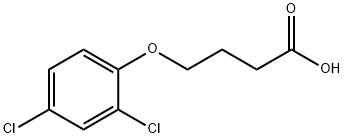
2,4-DB is a post-emergence herbicide that is used to control broadleaved weeds. It is highly soluble in water and most organic solvents. It is relatively volatile but it may leach to groundwater under certain conditions. It is not persistent in soil systems but may tend to be persistent in aquatic systems. It is moderately toxic to mammals and there is some concern regarding its potential for bioaccumulation. It is moderately toxic to birds, earthworms, honeybees and most aquatic organisms.
White to light-brown crystalline solid. May be
shipped as a concentrate to be mixed with water and used
as a spray. Slight phenolic odor.
4-(2,4-Dichlorophenoxy)butanoic Acid is a herbicide.
ChEBI: A monocarboxylic acid that is butyric acid in which one of the hydrogens at position 4 is replaced by a 2,4-dichlorophenoxy group. A selective post-emergence herbicide.
2,4-DB (is manufactured through a multi-step chemical synthesis process that begins with the preparation of key intermediates such as 2,4-dichlorophenol and monochloroacetic acid. These compounds are first neutralized with sodium hydroxide to form sodium salts. The sodium 2,4-dichlorophenate is then condensed with sodium monochloroacetate to produce sodium 2,4-dichlorophenoxyacetate, which is further reacted with butyric acid derivatives to form 2,4-DB. The final product undergoes purification steps such as washing, stripping, and crystallization to ensure high purity and stability.
Colorless crystals. Slightly corrosive to iron. A chlorinated phenoxy herbicide. Soluble in organic solvents.
2,4-Dichlorophenoxybutyric acid is an organic acid. Neutralizes bases in exothermic reactions. Forms water soluble metal and amine salts. Hard water precipitates the calcium and magnesium salts from aqueous solutions of such salts.
Selective, systemic. Synthetic auxin causing stem and leaf malformations leading to death.
2,4-DB is a chlorophenoxy/arylox-
yalkanoic acid selective systemic herbicide used to control
annual and perennial broadleaf weeds in many field crops
such as alfalfa, peanuts, cereals and soybeans; used as a
defoliant. In the plant, the compound changes to 2,4-D and
inhibits growth at the tips of stems and roots.
UN3077 Environmentally hazardous substances,
solid, n.o.s., Hazard class: 9; Labels: 9-Miscellaneous haz-
ardous material, Technical Name Required.
2,4-DB is a weak organic acid. Keep away from oxidizers, sulfuric acid, caustics, ammonia, aliphatic amines, alkanolamines, isocyanates, alkylene oxides, and epichlorohydrin. Corrosive to iron, aluminum, zinc, and possibly other metals, especially in the presence of moisture.
Do not discharge into drains
or sewers. Dispose of waste material as hazardous waste
using a licensed disposal contractor to an approved landfill.
Consult with environmental regulatory agencies for guid-
ance on acceptable disposal practices. Incineration with
effluent gas scrubbing is recommended. Containers must be
disposed of properly by following package label directions
or by contacting your local or federal environmental control
agency, or by contacting your regional EPA office