4-CPA is a plant growth regulator. It is moderately soluble in water and is quite volatile. Little is known about its persistence in soil and aquatic systems. It is moderately toxic to mammals and has a high potential for bioaccumulation. It is also a recognised irritant. It is moderately toxic to birds, honeybees and most aquatic organisms. However, it has a relatively low toxicity to fish.
white to light beige powder
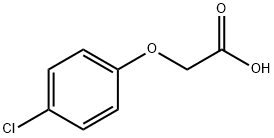
4-chlorophenoxy acetic acid (4-CPA), a chlorine derivative of phenoxyacetic acid (PA), is a plant growth regulator used as a herbicide.
2-(4-Chlorophenoxy)acetic Acid is used in the synthesis of a new class of hypoxia-inducible factor-1 inhibitors.
ChEBI: A chlorophenoxyacetic acid that is phenoxyacetic acid carrying a chloro substituent at position 4.
The production of (4-chlorophenoxy)acetic acid involves a multi-step organic synthesis starting with chlorinated aromatic precursors. Typically, 4-chlorophenol is reacted with chloroacetic acid or its derivatives under controlled conditions to form the ether linkage, yielding the phenoxyacetic acid structure. The reaction is often carried out in the presence of a base (such as sodium hydroxide) and a solvent like ethanol or tetrahydrofuran, followed by acidification to isolate the product.
4-Chlorophenoxyacetic acid is a herbicide. Degradation of 4-chlorophenoxyacetic acid in aqueous medium by advanced electrochemical oxidation processes, using an undivided cell containing a Pt anode has been reported.
Moderately toxic; mutagen.
4-Chlorophenoxyacetic acid is a synthetic auxin, that is used to induce parthenocarpic ovary growth on flowers of wild type plants.
Auxin-transport inhibitor. Absorbed by tissue and translocated to roots
Moderately toxic by
ingestion and intraperitoneal routes. Human
mutation data reported. When heated to
decomposition it emits toxic fumes of Cl-.
Crystallise the acid from EtOH. It is a plant growth substance and a herbicide. [Beilstein 6 IV 845.]
Plant Growth Regulator; Herbicide