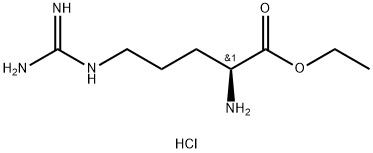
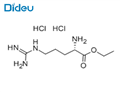
The most common method for synthesizing L-arginine ethyl ester dihydrochloride is to start with the corresponding amino acid, convert it to an acyl chloride, and then react it with ethanol to obtain the target product. The specific steps involve slowly adding alanine dropwise to a mixture of ethanol and thionyl chloride at a low temperature, typically -5°C to 0°C. The mixture is then stirred at a temperature higher than the boiling point of ethanol, allowing the reaction system to stabilize under reflux for several hours. Subsequently, the solution is vacuum distilled to dryness. Since hydrogen chloride is produced during the reaction, the product is L-arginine ethyl ester hydrochloride. Because this reaction requires minimal processing, the yield is usually quite high.
L-Arginine Ethyl Ester Dihydrochloride is a derivative of L-Arginine (A769505), an essential amino acid for human development. Precursor for nitric oxide. Ammonia detoxicant (hepatic failure); diagnostic aid (pituitary function).