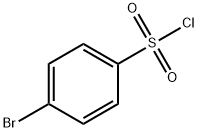
mixture of thiol (1 mmol), 30% H₂O₂ (3 mmol, 0.3 mL), and ZrCl₄ (1 mmol, 0.233 g) was stirred in MeCN (5 mL) at 25°C for an appropriate time. As shown by TLC, after the reaction was complete, the reaction mixture was quenched by adding H₂O (10 mL) and extracted with EtOAc (4 × 5 mL). The extract was dried with anhydrous MgSO₄, and the filtrate was evaporated under vacuum to give 4-bromobenzenesulfonyl chloride.
white to beige crystals or crystalline powder
4-Bromobenzenesulfonyl chloride is used for identification of amines, and also in the synthesis and inhibition studies of substituted N-L-histidinylphenylsulfonyl hydrazide.
Identification of amines.
4-Bromobenzenesulfonyl chloride is used as activating agent in the synthesis of oligodeoxyribo- and oligoribo- nucleotides in solution. It also used in the synthesis of 4-(N-allylsulfamoyl)phenylboronic acid and in protection of amines as 4-bromobenzenesulfonamides.
Wash the sulfonyl chloride with cold water, dry and recrystallise it from pet ether, or from ethyl ether cooled in powdered Dry-Ice after the ether solution had been washed with 10% NaOH until colourless, then dry it with anhydrous Na2SO4. Alternatively dissolve it in CHCl3, wash it with H2O, dry (Na2SO4), evaporate and recrystallise it. [Huntress & Carten J Am Chem Soc 62 511 1940.] Test for the SO2Cl group by dissolving it in EtOH and boiling with NH4CNS whereby a yellow amorphous precipitate forms on cooling. [Beilstein 11 IV 162.]