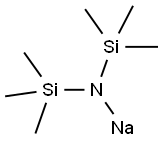
Slightly yellow to light beige crystalline powder
mp 171–175 °C; bp 170 °C/2 mmHg.
Sodium bis(trimethylsilyl)amide is a synthetically useful reagent in that it combines both high basicity and nucleophilicity, each of which may be exploited for useful organic transformations such as selective formation of enolates, preparation of Wittig reagents, formation of acyl anion equivalents, and the generation of carbenoid species. As a nucleophile, it has been used as a nitrogen source for the preparation of primary amines.It is useful as a sterically hindered base and as a nucleophile.
Significantly accelerated the polymerization of pheneylacetylene in conjunction with rhodium (I) catalysis
It is a strong base; deprotonates ketones and esters to generate enolate derivative.
Sodium bis(trimethylsilyl)amide solution (NaHMDS) is widely used as a strong base in organic synthesis for deprotonation reactions and base-catalyzed reactions. It is also involved in the generation of enolates, Wittig reagents and carbenes.
It can be sublimed at 170o/2mm (bath temperature 220-250o) onto a cold finger, and can be recrystallised from *C6H6 (its solubility is: 10g in 100mL at 60o). It is slightly soluble in Et2O and is decomposed by H2O. [Wannagat & Niederprüm Chem Ber 94 1540 1961.]It is available commercially under N2 in Sure/Seal bottles in tetrahydrofuran (various concentrations) and at ~0.6M in toluene. [Beilstein 4 IV 4014.]