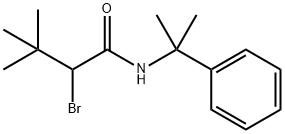
Bromobutide is a post-emergence herbicide mainly used in Japan, It has a low aqueous solubility and is a moderately volatile substance. It may be prone to drift. Little information is available regarding its environmental fate. It is moderately toxic to fish. It has a low mammalian toxicity via the human route but other human health information is scant.
The prodrug is colorless to yellow crystal. Vapor pressure 5.92×10⁻²mPa(25℃).KowlgP=3.46(25℃),Henry's constant 6.53 Pa -m3/mol(calculated). Solubility in water 3.54mg/L(25℃);Solubility in other solvents(25℃ ,g/L):xylene 4.7,methanol 35,n-hexane 0.5.Stable under normal storage conditions.
Bromobutide is a pesticide.
ChEBI: A monocarboxylic acid amide having a 2-phenylpropan-2-yl substituent attached to the amide nitrogen and a 1-bromo-2,2-dimethylpropyl group attached to the carbonyl carbon.
Bromobutide is commercially synthesised through a multi-step process involving the reaction of 2-bromo-3,3-dimethylbutanoyl chloride with 2-phenyl-2-propylamine, forming the final amide structure. The synthesis typically includes chlorination using thionyl chloride, bromination with bromine in carbon tetrachloride, and coupling in solvents like chlorobenzene under mild conditions.
Inhibition of 4-hydroxyphenyl-pyruvate dioxygenase, bleaching