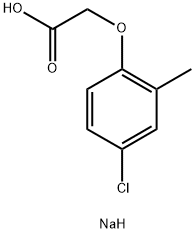
Commercial manufacture of MCPA-sodium typically begins with the chlorination of para-cresol to form 4-chloro-2-methylphenol, which is then carboxylated, most commonly via the Kolbe–Schmitt process, to yield the acid MCPA. The crude acid is purified and neutralised with sodium hydroxide in aqueous solution, producing the water-soluble sodium salt.
Colorless plates. Corrosive. Used as an herbicide.
MCPA SODIUM is a salt of a chlorinated benzoic acid.
Selective, systemic with translocation. Synthetic auxin.
Poison by intraperitoneal route. Moderately toxic by ingestion and subcutaneous routes. Experimental reproductive effects. Mutation data reported. When heated to decomposition it emits toxic fumes of Cland Na2O.