A widely used herbicide for post-emergence control. It has a low aqueous solubility and a low volatility. There is a low potential for leaching to groundwater based on its chemical properties. It is not expected to be persistent in soil or water systems. It is moderately toxic via the oral route to mammals, is an endocrine disrupting chemical and a skin sensitiser. It is highly toxic to fish and aquatic invertebrates but less so to other aquatic and terrestrial biodiversity.
Bromoxynil is a colorless to white crystalline
solid or tan powder. Odorless (pure).
Selective contact foliage-applied herbicide used to control many broad-leaved weeds
such as bindweed, chickweed and Veronica spp. in cereals.
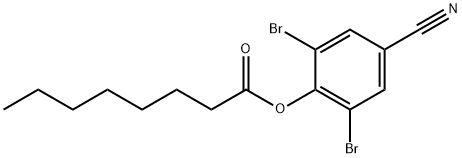
The industrial synthesis begins with bromoxynil which is reacted with octanoic acid (caprylic acid) or its activated derivative, typically octanoyl chloride, in the presence of a base such as pyridine or triethylamine. This esterification process replaces the hydroxyl group on bromoxynil with the octanoate moiety, enhancing the compound’s lipophilicity and improving its formulation stability and plant uptake. The reaction is carried out under controlled temperature and solvent conditions to maximise yield and minimise side reactions.
A solid. Used as a selective contact herbicide.
Bromoxynil octanoate is an ester. Readily hydrolyzed to bromoxynil and octanoate at pH's exceeding 9.
Highly toxic, may be fatal if inhaled, swallowed or absorbed through skin. Avoid any skin contact. Effects of contact or inhalation may be delayed. Fire may produce irritating, corrosive and/or toxic gases. Runoff from fire control or dilution water may be corrosive and/or toxic and cause pollution.
Non-combustible, substance itself does not burn but may decompose upon heating to produce corrosive and/or toxic fumes. Containers may explode when heated. Runoff may pollute waterways.
Flammability and Explosibility
Not classified
Herbicide: A U.S. EPA restricted Use Pesticide (RUP).
Herbicide used for alfalfa seedlings, barley, corn, flax,
garlic, grasses, mint, oats, onions, popcorn, rye, sorghum,
triticale, wheat. See also below.
BROMINAL®-W; BUCTRIL®
Bromoxynil octoate; NPH-1320®
Select contact action with some systemic activity. Inhibits photosynthesis (photosystem II).
Bromoxynil is a hydroxybenzonitrile
herbicide used for postemergent control of broadleaf
weeds; on alfalfa, garlic, corn, sorghum, flax, cereals,
turf and on pasture and rangelands. A United States
Environmental Protection Agency RUP.
Chemical/Physical. Emits toxic fumes of nitrogen oxides and bromine when heated
to decomposition (Sax and Lewis, 1987). Hydrolyzes, especially at pH >9, to bromoxynil
and octanoic acid (Hartley and Kidd, 1987; Worthing and Hance, 1991).
UN2588 Pesticides, solid, toxic, Hazard Class:
6.1; Labels: 6.1—Poisonous materials, Technical Name
Required.
A weak acid; keep away from bases and
alkalies. React with boranes, alkalies, aliphatic amines,
amides, nitric acid, sulfuric acid. Keep away from oxidizers
(chlorates, nitrates, peroxides, permanganates, perchlorates,
chlorine, bromine, fluorine, etc.) and strong acids.
Do not discharge into drains
or sewers. Dispose of waste material as hazardous waste
using a licensed disposal contractor to an approved landfill.
Incineration with effluent gas scrubbing is recommended.
Consult with environmental regulatory agencies for guidance
on acceptable disposal practices. If allowed,
Incineration with effluent gas scrubbing is recommended.
Containers must be disposed of properly by following
package label directions or by contacting your local or federal
environmental control agency, or by contacting your
regional EPA office.