Description
Bromobutide is a post-emergence herbicide mainly used in Japan, It has a low aqueous solubility and is a moderately volatile substance. It may be prone to drift. Little information is available regarding its environmental fate. It is moderately toxic to fish. It has a low mammalian toxicity via the human route but other human health information is scant.
Chemical Properties
The prodrug is colorless to yellow crystal. Vapor pressure 5.92×10⁻²mPa(25℃).KowlgP=3.46(25℃),Henry's constant 6.53 Pa -m3/mol(calculated). Solubility in water 3.54mg/L(25℃);Solubility in other solvents(25℃ ,g/L):xylene 4.7,methanol 35,n-hexane 0.5.Stable under normal storage conditions.
Uses
Bromobutide is a pesticide.
Definition
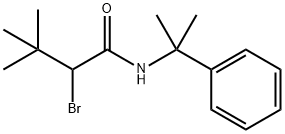
ChEBI: A monocarboxylic acid amide having a 2-phenylpropan-2-yl substituent attached to the amide nitrogen and a 1-bromo-2,2-dimethylpropyl group attached to the carbonyl carbon.
Production Methods
Bromobutide is commercially synthesised through a multi-step process involving the reaction of 2-bromo-3,3-dimethylbutanoyl chloride with 2-phenyl-2-propylamine, forming the final amide structure. The synthesis typically includes chlorination using thionyl chloride, bromination with bromine in carbon tetrachloride, and coupling in solvents like chlorobenzene under mild conditions.
Mechanism of action
Inhibition of 4-hydroxyphenyl-pyruvate dioxygenase, bleaching