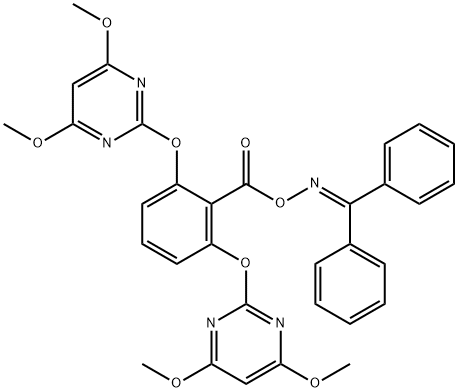
Pyribenzoxim is a post-emergence herbicide. It has a low aqueous solubility and is volatile. Whilst data is sparse it indicates that the chemical is not persistent in soil systems. It has a low mammalian toxicity and is a recognised irritant. It is moderately toxic to birds, fish and honeybees.
Pure product is white solid. m.p. 128~130℃, vapor pressure <7.4×10⁻⁶Pa. solubility in water is 3.5mg/L at 25℃. field half-life is 7d.
Pyribenzoxim can be used in biological study of production of acetolactate synthase inhibitor herbicide tolerant Brassica napus mutants.
Pyribenzoxim is commercially produced through a convergent 4–6 step synthesis that begins with the preparation of the 4,6-dimethoxy-2-(methylsulfonyl)pyrimidine core via chlorination of 4,6-dihydroxypyrimidine, followed by methoxylation using sodium methoxide in methanol and selective oxidation of the 2-methylthio group to methylsulfonyl. Separately, the benzoxazinone moiety is constructed from 2-amino-5-chlorobenzoic acid through cyclocondensation with benzoyl chloride under basic conditions. The key coupling occurs via nucleophilic aromatic substitution, where the deprotonated benzoxazinone displaces the sulfonyl group yielding pyribenzoxim after acidification and crystallisation from ethanol or toluene.
Broad-spectrum and inhibits plant amino acid synthesis - acetohydroxyacid synthase AHAS.