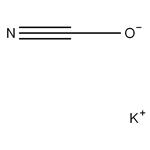
Potassium cyanate(KOCN, also written as KCNO) is a colourless crystalline powder or tetragonal crystal. It has the odour of hydrogen cyanide. It is toxic. It decomposes when heated to 700–900 °C. It is soluble in hot water, methanol, furan and glycerol, and slightly soluble in ethanol. As an important source of the cyanate ion (OCN⁻), potassium cyanate is used in the manufacture of organic chemicals and drugs, in the treatment of sickle-cell anaemia, and as an herbicide.
Potassium cyanate is used as an inhibitor to prevent sickling of erythrocytes and has potential use as a treatment for sickle-cell anemia. Potassium cyanate is also used as a reagent to carbamylate proteins.
Potassium cyanate is used as chemical intermediate and
as a weed killer. It is also used for the heat treatment of
metals.
ChEBI: Potassium cyanate is a cyanate salt and a one-carbon compound. It has a role as a herbicide.
Potassium cyanate can be prepared by reacting urea with alkali hydroxide or carbonates at high temperatures.
Flammability and Explosibility
Not classified
Poison by
intraperitoneal route. Moderately toxic by
ingestion. Causes irritation of the
gastrointestinal tract. An herbicide. It is said
to be slowly metabolized in the body to
cyanide but does not have high toxicity of
cyanides. When heated to decomposition it
emits very toxic fumes of CNand K2O.
ErnerW synthesized potassium cyanate from potassium carbonate and urea, using sulfoxide or sulfone as a solvent [9]. The invention is characterized by the use of solvents with strong solvency for urea and potassium carbonate, such as methyl ethyl sulfoxide, diethyl sulfoxide, etc. ErnerW, in his patent example, dissolved 5 mol of potassium carbonate and 13 mol of urea in 4.0 of methyl ethyl sulfoxide, the reaction was heated and stirred with nitrogen, and the temperature of the reaction was increased to 180C in 1h, with ammonia, 24.0c478 water vapour, Carbon dioxide overflow, after 0.25h, the temperature rises to 195 C. At this time, the reaction can be terminated when a sample is taken from the reactor and tested with barium nitrate for the absence of carbonate, the product is cooled to room temperature, filtered, and washed with anhydrous ethanol to obtain 10 mol portions of potassium cyanate, yield 90%.
Common impurities include ammonia and bicarbonate ion (from hydrolysis). Purify it by preparing a saturated aqueous solution at 50o, neutralising with acetic acid, filtering, adding two volumes of EtOH and keeping for 3-4hours in an ice bath. (More EtOH can lead to co-precipitation of KHCO3.) Filter, wash it with EtOH and dry it rapidly in a vacuum desiccator (P2O5). The process is repeated [Vanderzee & Meyers J Chem Soc 65 153 1961].