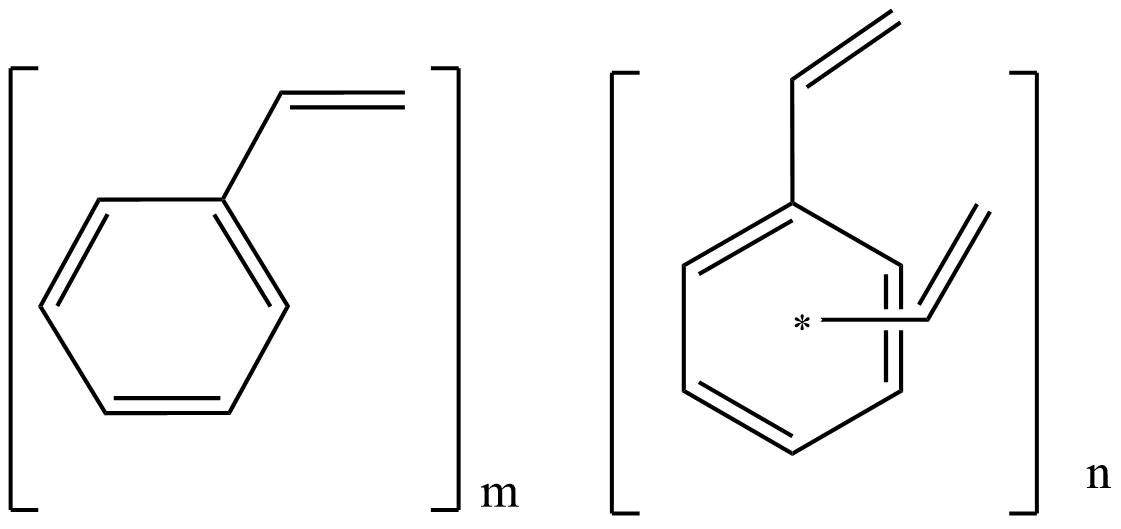
solid, often supplied as small beads
Poly(styrene-divinylbenzene) is used in chromatographic separation medium. It is also used for the removal of phenolic inhibitors: hydroquinone, hydroquinone monomethyl ether and tert-butylcatechol. It is widely used as column packing material in liquid chromatography for separation of both organic and inorganic ions. Styrene-divinylbenzene copolymer is used in inorganic trace analysis for solid phase extraction preconcentration.
Amberlite XAD-2, a hydrophobic copolymer of styrene-divinylbenzene resin which requires longer purification process and is used as a sorbent. Amberlite XAD-2 resin depending upon the aromaticity and size of the hydrophobic groups sorbs organic compounds through low-energy physical interactions.
Polystyrene resin is produced by suspension polymerization. Ethyl benzene is dehydrogenated in the presence of catalyst and converted into crude styrene, which is sent to the polymerization section after fractionation to increase the purity of styrene to more than 99.5%, and then purified water, polyvinyl alcohol (dispersant), dibenzoyl peroxide (initiator) and styrene are introduced into the polymerization kettle according to a certain proportion, and polymerization is carried out at 85 and normal pressure to obtain transparent bead material, which is washed, centrifuged and dried as the finished product.