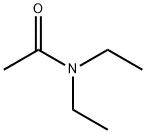
The industrial synthesis route for N,N-diethylacetamide is as follows: 3 tons of acetic acid are pumped into the bottom of a 10 m³ packed column. Diethylamine is pumped into the bottom of the column at a rate of 200 kg/h. The temperature is raised to 60°C to establish reflux. Once the column temperature stabilizes, diethylamine is collected from the top of the column at a rate of 200 kg/h and returned directly to the bottom of the distillation column. Process wastewater is collected from the second section of the distillation column at a rate of 36 kg/h and treated in a wastewater treatment system. When the purity of the product in the bottom of the column exceeds 98.0%, the ethylenediamine flow is stopped, and distillation is performed to obtain 5.31 tons of crude N,N-diethylacetamide, with a yield of 94.3% and a purity of 98.6%. Then, 100 kg of calcium oxide (118% excess) is added to the crude product, and the mixture is stirred at 60°C for 1 hour. Distillation yields 5.08 tons of refined N,N-diethylacetamide. This method uses ethylenediamine and acetic acid as raw materials. It promotes the forward reaction by removing water and recycled diethylamine produced in the reaction through reactive distillation. Compared to existing processes, this method is simpler, as the reaction and distillation sections share a single set of equipment, requiring less floor space and lower equipment investment. Furthermore, it eliminates the need for catalysts, making it more economical and efficient than previous methods.
N,N-Diethylacetamide was used to investigate the spectroscopic properties ofN,N-diethyl-2-[(4-substituted)phenylsulfinyl] acetamides. It is commonly used as drug solvent.
Chemistry Letters, 18, p. 1983, 1989
The Journal of Organic Chemistry, 59, p. 4035, 1994
DOI: 10.1021/jo00094a004
N,N-Diethylacetamide is commonly used as drug solvent.
Moderately toxic by
ingestion and intraperitoneal routes.
Questionable carcinogen with experimental
tumorigenic data. Flammable when exposed
to heat or flame. To fight fire, use foam,
mist, CO2, dry chemical. When heated to
decomposition it emits toxic fumes of NOx.
Dissolve the amide in cyclohexane, shake with anhydrous BaO and then filter. The procedure is repeated three times, and the cyclohexane is distilled off at atmospheric pressure. The crude amide is also fractionally distilled three times from anhydrous BaO. [Beilstein 4 III 349.]