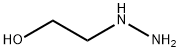
2-Hydroxyethylhydrazine (HEH) is the primary decomposition product of the high-energy ionic liquid 2-hydroxyethylhydrazinium nitrate (HEHN). As a hydrazine fuel, HEHN is the most widely used liquid monocomponent propellant in the aerospace sector. while HEH is a key target for investigating the reaction mechanism of HEHN.
Clear colorless oily liquid
(2-Hydroxyethyl)hydrazine is used as a plant growth regulant, a component in jet fuels, intermediate for organic synthesis especially heterocycles used in agrochemicals, pharmaceuticals, stabilizers and polymerizations, Chain extender for urethane formulations, corrosion inhibitor.
2-Hydroxyethylhydrazine is used as an intermediate, plant growth regulator, flowering inducer for pineapples.
2-Hydroxyethylhydrazine is prepared by heating about 2 to 17 parts of hydrazine hydrate dissolved in water to about 30℃ to about 100℃. in a closed system. Then, 1 part of ethylene oxide is gradually added to the hydrazine hydrate, and the temperature of the reaction mixture is maintained in the range of about 30℃ to 70℃ during the addition.
ChEBI: 2-hydrazinoethanol is a member of hydrazines. It has a role as a herbicide. It is functionally related to an ethanol.
2-Hydroxyethylhydrazine reacts with β-diketones having strong electron-withdrawing substituents to yield 5-hydroxy-4,5-dihydropyrazoles.
Moderate fire risk. Irritant.
2-Hydroxyethylhydrazine (HEH) is a potent and highly specific inhibitor of the phosphatidylethanolamine methylation pathway in Saccharomyces cerevisiae. Following HEH addition to culture medium, the incorporation of L-[3-14C]serine, L-[methyl-14C]methionine, and S-adenosyl-L-[methyl-14C]methionine into phosphatidylcholine was markedly reduced. In the presence of this inhibitor, cells ceased growth with an IC50 value of 66 pM. Although cellular activity remained unaffected, the addition of choline restored cell growth. This indicates that active phospholipid methylation is unnecessary as long as phosphatidylcholine is supplied via the CDP-choline pathway. The restoration of cell growth by choline suggests that HEH's primary target in vivo is phospholipid methylation.
Inhibits phospholipid methylation in yeast.
The general procedure for synthesizing 2-hydrazinoethanol from ethylene oxide was as follows: ethylene oxide was added to a VO1 liquefied gas storage tank and pressurized to 1.0~1.5 MPa using nitrogen. 80% hydrazine hydrate was added to a VO2 storage tank, and the molar ratio of hydrazine hydrate to ethylene oxide was controlled to be 8:1. the hydrazine hydrate was fed at a total feed flow rate of 2.0 L/h via feed pumps PO1 and PO2, respectively. The temperature of the micro-mixer was maintained at 40°C, the temperature of the cracking reactor was set at 60°C, the temperature of the micro-heat exchanger was controlled in the range of 0-10°C, and the back pressure of the back-pressure valve was set at 1.5-2.5 MPa. The two liquid feedstocks were mixed in a CPMM-R300 micro-mixer and then entered into the cracking reactor for further reaction. The reaction liquid is cooled by a micro heat exchanger and then micro-fed to the receiving vessel. Most of the water and excess hydrazine hydrate were removed by decompression distillation, and the final colorless oily liquid 2-hydroxyethylhydrazine was obtained. The purity of the product was 89.5% and the yield was 98% by GC. Finally, the entire microreactor system was washed using water.
[1] Patent: CN104876833, 2016, B. Location in patent: Paragraph 0037; 0038
[2] Patent: EP2952509, 2015, A1. Location in patent: Paragraph 0041; 0042
[3] Bulletin de la Societe Chimique de France, 1939, vol. <5> 6, p. 708,714
[4] Ukrainskii Khimicheskii Zhurnal (Russian Edition), 1928, vol. 3, p. 125,128
[5] Chem. Zentralbl., 1930, vol. 101, # I, p. 2867