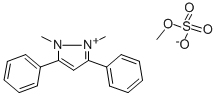
Difenzoquat metilsulfate is a herbicide mainly used to control wild oats. It is highly soluble in water and has a low volatility. It can be environmentally persistent depending on local conditions. It tends to be moderately toxic to biodiversity. Difenzoquat metilsulfate is also moderately toxic to mammals via the oral route.
Pure product is white solid, hygroscopic. m.p. 155~157°C, vapor pressure 1.33×10⁻⁵Pa (20°C), relative density 1.13. Solubility in water is 76% (25°C), 78% (37°C), 85% (56°C); slightly soluble in methanol, ethanol; insoluble in petroleum hydrocarbons. Aqueous solution (pH 3-3.4) is stable to light and acidic conditions, unstable to alkali, no effect on storage at 120℃ for 169h. Industrial content >96%, m.p. 150~160℃.
DIFENZOQUAT METHYLSULFATE is used to control wild oats in wheat, barley, ax, maize, rye grass, vetches and rye grass crops.
Difenzoquat Methyl Sulfate could have agricultural uses. It could help reduce downward migration of pesticides in soil/turf to allow it to better target pests.
DIFENZOQUAT METHYLSULFATE is Herbicide; agricultural fungicide.
Difenzoquat metilsulfate is commercially synthesized via a process that begins by reacting 1-methyl-3,5-diphenylpyrazole with concentrated sulfuric acid and methanol at elevated temperatures (~160 DegC), where methanol is gradually distilled and replenished to drive the reaction forward. After sulfonation, the mixture is cooled and treated with 1,2-dichloroethane to facilitate crystallisation and purification of the final product.
Selective, absorbed by foliage. Acts via the rapid destruction of cell membranes.
Poison by ingestion. Moderatelytoxic by skin contact. When heatedto decomposition it emits very toxic fumes of NOx andSOx.
Soil. Though no products were reported, the half-life in soil is approximately 3 months (Hartley and Kidd, 1987).
Photolytic. Degrades photolytically to the volatile monomethyl pyrazole (Hartley and Kidd, 1987).
Chemical/Physical. May react with aluminum releasing hydrogen (Hartley and Kidd, 1987).