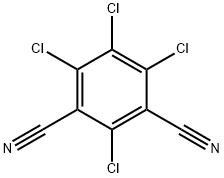
Chlorothalonil is a broad-spectrum organic fungicide mainly used to control fungi that threatens a number of agricultural crops, vegetables, trees, fruits, turf and paints, etc. It can also serves as a wood protectant, pesticide, acaricide, which is effective to kill mildew, bacteria, algae, and insects. Besides, it can commercially act as a preservative additive in several paints, resins, emulsions, coatings and can be used on commercial grasses such as golf courses and lawns.
Chlorothalonil was first registered by the EPA in 1966. It is environmentally persistent and binds strongly with soil, whose expected half-life in aerobic soils is one to three months. Chlorothalonil functions by reducing the intracellular glutathione molecules of fungal to alternate its forms which affects the essential enzymatic reactions of fungal, ultimately leading to cell death.
Chlorothalonil is a fungicide with a broad spectrum of activity used mainly in agriculture but also on turf, lawns and ornamental plants. It protects plants against a variety of fungal infections such as rusts, downy mildew, leaf spot, scabs, blossom blight and black pod. Crops protected include pome fruit, stone fruit, citrus, currants, cranberries, strawberries, bananas, vines, hops, tomatoes, green vegetables, tobacco, coffee, tea, soya bean, groundnuts, potatoes, onions, cereals and sugar beet. In addition, it is used in wood preservatives, fish net coatings and anti-fouling paints.
http://www.toxipedia.org/display/toxipedia/Chlorothalonil
http://pmep.cce.cornell.edu/profiles/extoxnet/carbaryl-dicrotophos/chlorothalonil-ext.html
https://en.wikipedia.org/wiki/Chlorothalonil
Chlorothalonil is a pesticide fungicide commonly used
in the cultivation of ornamental plants and flowers,
rice, and onions. In banana plantations it is used in
fumigations by airplanes. It can be used as a preservative
of paints and of woods. Chlorothalonil can
induce contact urticaria, irritant and allergic contact
dermatitis, erythema dychromicum perstans or
folliculitis mainly in agricultural workers, in those in
wood-related professions or in hortieulturists.
Chlorothalonil is a combustible, white, odorless, crystalline solid
Chlorothalonil is a non-systemic foliar fungicide with protective
activity. It is used to control a broad spectrum of fungal diseases in fruit
(pome, stone, citrus, etc.), berries, vegetables, cucurbits, root crops, soyabeans,
ornamentals and turf.
Chlorothalonil is a polychlorinated aromatic broad spectrum non-systematic fungicide. Chlorothalonil is used heavily in agriculture field on crops such as peanuts, potatoes and tomatoes. Chlorothaloni
l is a probable human carcinogen (Group B2) and is highly toxic to fish and aquatic invertabrates.
ChEBI: A dinitrile that is benzene-1,3-dicarbonitrile substituted by four chloro groups. A non-systemic fungicide first introduced in the 1960s, it is used to control a range of diseases in a wide variety of crops.
Chlorothalonil is produced commercially through a multi-step chemical synthesis involving chlorinated aromatic compounds. There are two main synthetic routes. The main method is chlorination of isophthalonitrile. This involves starting with isophthalonitrile and undergoing a chlorination step using chlorine gas under controlled conditions to produce chlorothalonil. Alternatively, chlorothalonil can be produced via the dehydration of tetrachloroisophthaloyl amide.
Colorless crystals or granules or light gray powder. Melting point 250-251°C. No odor when pure; technical grade has a slightly pungent odor. A fungicide formulated as water-dispersible granules, wettable powder, or dust.
Chlorothalonil is stable in neutral or acidic aqueous media. May react violently with strong oxidizing acids [Farm Chemicals Handbook]. Incompatible with other oxidizing agents such as peroxides and epoxides. Breaks down slowly in basic aqueous media (half-life 38.1 days at pH 9. [Farm Chemicals Handbook].
Chlorothalonil is an irritant to
the skin and eyes and has been reported to
produce allergic contact dermatitis in exposed
workers.
Literature sources indicate that Chlorothalonil is nonflammable.
Flammability and Explosibility
Not classified
Fungicide: Chlorothalonil is a broad-spectrum fungicide. It is used on vegetables, peanuts, potatoes, small fruits, trees, turf, roses, ornamentals, and other crops. In California, the top crops are tomatoes, onions, celery, and landscaping. It targets fungal blights, needlecasts, and cankers on conifer
trees. This is the second most used fungicide in the U.S. It can be found in formulations with many other pesticides
ATLAS CROPGARD®; BANOL C®; BB CHLOROTHALONIL®; BOMmHgDIER®; BRAVO®; BRAVO® 6 F; BRAVO® 500; BRAVO® 6 F; BRAVO ULTREX®; BRAVO-W-75®; CHILTERN OLE®; CONTACT® 75; DAC® 2787; DACONIL®; DACONIL® 2787 FUNGICIDE; DACONIL® 2787 W; DACONIL® F; DACONIL® M; DACONIL® TURF; DACOSOIL®; DIVA FUNGICIDE®[C]; ECHO®; EXOTHERM®; EXOTHERM TERMIL®; FORTURF®; FUNGINIL®; IMPACT EXCEL®; JUPITAL®; NUOCIDE®; OLE®; PILLARICH®; POWER CHLOROTHALONIL® 50; REPULSE®; RIDOMIL GOLD/BRAVO®; SICLOR®; SIPCAM® UK ROVER 5000; SWEEP®; TER-MIL®; TPN®; TPN (PESTICIDE)®; TRIPART FABER®; TRIPART ULTRAFABER®; TUFFCIDE®
Chlorothalonil is a fungicide widely used in the cultivation
of ornamental plants and flowers, rice, and
onions. In banana plantations it is used in fumigations
by airplanes. It can be used as a preservative of paints
and woods. It can induce contact urticaria, irritant and
allergic contact dermatitis, erythema dyschromicum
perstans, or folliculitis mainly in agricultural workers,
wood-related professions, or in horticulturists.
Non-systemic, broad-spectrum, foliar action with some protectant properties. Acts by preventing spore germination and zoospore motility. Multi-site activity.
Mechanism of action of this fungicide may be attributed
to inhibition of physiological activities of fungal cell constituents
by binding reaction. The reaction was observed in
buffer solution to substitute hydroxyethylthio radical(s) of
2-mercaptoethanol for chlorine radical(s) on the benzene
ring of the fungicide molecule preferably at 4-position
(i.e., also 6-) followed by other positions (5). Similar
reactions in fungal cells were observed between the
fungicide and glutathione and high molecular weight cell
constituents having a sulfhydryl group (5,6). The fungicide
inhibits activities of thiol-dependent enzymes such as
alcohol dehydrogenase, gyceraldehyde-3-phosphate dehydrogenase,
and malate dehydrogenase (5,6). Preliminary
addition of glutathione or dithiothreitol protects the thiol
enzymes from inhibition but later addition does not reverse
the enzyme inhibition. Chymotrypsin, a non-thiol enzyme,
was not inhibited by this fungicide. Binding of the fungicide
to the sulfhydryl group of cell constituents appears to
be the primary mode of its action.
Suspected carcinogen with experimental carcinogenic data. Moderately toxic by skin contact and intraperitoneal routes. Mildly toxic by ingestion. Mutation data reported. When heated to decomposition it emits very toxic fumes of Cl-, NOx, and CN-. See also NITRILES.
Chlorothalonil is a broad spectrum fungicide; used as fungicide in coatings; caulk, wood preservative, and antifouling systems. Therefore, people involved in its manufacture, formulation, and application can be exposed.
If this chemical gets into the eyes, remove anycontact lenses at once and irrigate immediately for at least20�30 min, occasionally lifting upper and lower lids. Seekmedical attention immediately. If this chemical contacts theskin, remove contaminated clothing and wash immediatelywith soap and water. Seek medical attention immediately. Ifthis chemical has been inhaled, remove from exposure,begin rescue breathing (using universal precautions, including resuscitation mask) if breathing has stopped and CPR ifheart action has stopped. Transfer promptly to a medicalfacility. When this chemical has been swallowed, get medical attention. Give large quantities of water and inducevomiting. Do not make an unconscious person vomit
Chlorothalonil was not mutagenic in a
variety of assays, nor did it bind to DNA.3 The
compound does not appear to have genotoxic
potential and probably exerts its carcinogenic
action in rodents via a nongenotoxic mechanism.
3 Rodent models may be a poor predictor
of carcinogensis in humans because of species
differences in metabolic pathways leading to
carcinogenesis in the kidney and the lack of a
comparable organ (forestomach) in humans.
The IARC has determined that there is
sufficient evidence for carcinogenicity of
chlorothalonil in experimental animals and
inadequate evidence in humans.
Biological. From the first-order biotic and abiotic rate constants of chlorothalonil in
estuarine water and sediment/water systems, the estimated biodegradation half-lives were
8.1–10 and 1.8–5 days, respectively (Walker et al., 1988).
Soil. Metabolites identified in soil were 1,3-dicyano-4-hydroxy-2,5,6-trichlorobenzene,
1,3-dicarbamoyl-2,4,5,6-tetrachlorobenzene and 1-carbamoyl-3-cyano-4-hydroxy-2,5,6-
trichlorobenzene (Rouchaud et al., 1988). The half-life was reported as 4.
Groundwater. According to the U.S. EPA (1986) chlorothalonil has a high potential
to leach to groundwater
Plant. Degrades in plants to 4-hydroxy-2,5,6-trichloroisophthalonitrile (Hartley and
Kidd, 1987), 1,3-dicyano-4-hydroxy-2,5,6-trichlorobenzene and 1,3-dicarbamoyl-2,4,5,6-
tetrachlorobenzene (Rouchaud et al., 1988). No evidence of degradation products were
reported in apple foliage 15 days after application. The half-life of chlorothalonil was 4.1
days (Gilbert, 1976)
By in vitro incubation of 14C-chlorothalonil (CTL) with
rat stomach, duodenum, and cecum contents, with
dog stomach, duodenum, and colon contents, and with
human feces and stomach contents, transformation of
CTL mostly occurs in rat cecum contents, dog colon contents, and human feces, in which unchanged
CTL accounts for 46.7, 29.7, and 22.6% of applied
radioactivity, respectively. In those incubations,
the identified metabolites are 2,5,6-trichloro-4-
methylthioisophthalonitrile, 2,5,6-trichloro-4-
thioisophthalonitrile, 3-thia-1-cyano-2,5,6-
trichloroisoindolinone, 2,5,6-trichloro-4-
hydroxyisophthalonitrile, and 2,5,6-
trichloroisophthalonitrile. In rats, CTL is transformed
to 4,6-bis(N-acetylcystein-S-yl)-2,5-
dichloroisophthalonitrile.
The photolysis of CTL solutions in alcohols
(ethanol and methanol separately) with exposure to
UV irradiation yields 4,5,7-trichloro-6-cyano-3-
methylbenzo-g -lactone and dichlorobenzo-bis-g -lactone
derivatives as major degradation products in ethanol.
In methanol, 4,5,7-trichloro-6-cyanobenzo-g -lactone is
the only photoproduct detected.
Degradation pathways of chlorothalonil in upland and
paddy soils (7) and by soil bacteria (8) were studied,
and most initial products were identified to be the
results of chlorine substitution reactions, by hydrogen
(i.e., dechlorination), by hydroxyl, and by methylthio
groups. These reactions took place first at the 4-position
of the ring followed by reactions at other positions as
in the reaction with thiol compounds. Paddy
soil degraded the fungicide faster than did upland
soil. Chlorine substitution reaction at 4-position of the
fungicide molecule was also reported in benzene solution
under sunlight, and the phenyl-substituted product was
identified (9). Similar photolysis was observed in
other aromatic hydrocarbon solutions but not in acetone,
hexane, and ether solutions.
Color Code—Blue: Health Hazard/Poison: Storein a secure poison location. Prior to working with chlorothalonil you should be trained on its proper handling andstorage. Store in tightly closed containers in a cool, wellventilated area. Metal containers involving the transfer ofthis chemical should be grounded and bonded. Drums mustbe equipped with self-closing valves, pressure vacuumbungs, and flame arresters. Use only nonsparking tools andequipment, especially when opening and closing containersof this chemical. Sources of ignition, such as smoking andopen flames, are prohibited where this chemical is used,handled, or stored in a manner that could create a potentialfire or explosion hazard. A regulated, marked area shouldbe established where this chemical is handled, used, orstored in compliance with OSHA Standard 1910.1045
UN3276 Nitriles, liquid, toxic, n.o.s., Hazard Class: 6.1; Labels: 6.1-Poisonous materials, Technical Name Required, Potential Inhalation Hazard (Special Provision 5). UN2588 Pesticides, solid, toxic, Hazard Class: 6.1; Labels: 6.1-Poisonous materials, Technical Name Required
Chlorothalonil is stable to aqueous hydrolysis at pH values above 7. It is
hydrolysed slowly at pH 9 via dechlorination to yield 4-hydroxy-2,5,6-
trichloroisothalonitrile (2) and oxidation/hydration of one of the nitrile
groups to yield 3-cyano-2,4,5,6-tetrachlorobenzamide (3) (Szalkowski and
Stallard, 1977).
Chlorothalonil’s production and use as a broad-spectrum,
nonsystemic, protectant pesticide results in its direct release to the
environment. Its uses as a wood protectant, antimold and antimildew
agent, bactericide, microbiocide, algaecide, insecticide,
and acaricide are additional routes of release. If released to air,
chlorothalonil will exist in both the vapor and particulate phases
in the ambient atmosphere. Vapor-phase chlorothalonil will be
degraded slowly in the atmosphere by reaction with
photochemically produced hydroxyl radicals (reaction half-life
~7 years). Direct photolysis may also occur. Chlorothalonil is
removed from the atmosphere by wet and dry deposition. If
released to soil, chlorothalonil is expected to have lowmobility or
be immobile, based on Koc values in the range of 900–7000
measured in four soils. Volatilization from moist or dry soil
surfaces is not expected to be important based on a Henry’s Law
constant of 2.5�×10-7 atm-cummol-1. Aerobic biodegradation
half-lives of chlorothalonil in four different soils ranged from
10 to 40 days. If released into water, chlorothalonil is expected
to adsorb to suspended solids and sediment in the water column.
Contact with strong oxidizers may cause a fire and explosion hazard. Thermal decomposition may include fumes of hydrogen cyanide. Nitriles may polymerize in the presence of metals and some metal compounds. They are incompatible with acids; mixing nitriles with strong oxidizing acids can lead to extremely violent reactions. Nitriles are generally incompatible with other oxidizing agents such as peroxides and epoxides. The combination of bases and nitriles can produce hydrogen cyanide. Nitriles are hydrolyzed in both aqueous acid and base to give carboxylic acids (or salts of carboxylic acids). These reactions generate heat. Peroxides convert nitriles to amides. Nitriles can react vigorously with reducing agents. Acetonitrile and propionitrile are soluble in water, but nitriles higher than propionitrile have low aqueous solubility. They are also insoluble in aqueous acids.
Incineration in a unit operating @ 850�C equipped with off-gas scrubbing equipment.