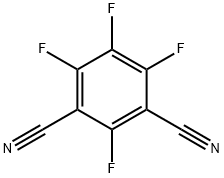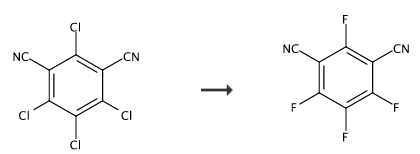
In a 250 mL three-necked flask, 150 mL of dried sulfolane was added, followed by 26.6 g of dried chlorothalonil. Under mechanical stirring, the mixture was heated to 70 °C to completely dissolve the chlorothalonil. 25.0 g of anhydrous potassium fluoride and 0.5 g of 18-crown ether-6 were quickly added as a phase transfer catalyst. A drying tube was attached to one side of the flask. The reaction was then carried out at 160-180 °C for 8 hours. After cooling to room temperature, the precipitate (KF + KCl) was removed by filtration. The precipitate was washed 2-3 times with 20 mL of sulfolane (approximately 24.9 g in weight). The filtrates were combined and poured into 500 mL of water. The mixture was magnetically stirred for 2 hours. Filtering yielded 17.6 g of precipitate, which was dried and recrystallized from cyclohexane to obtain white needle-like crystals weighing approximately 16.4 g (70.7% yield).
2,4,5,6-Tetrafluoroisophthalonitrile and derivatives have been used to study their antimicrobial activity against Staphylococcus aureus, Bacillus cereus (Gram-pos. bacteria), Escherichia coli, Pseudomonas aeruginosa (Gram-neg. bacteria); and Candida albicans (Fungi).