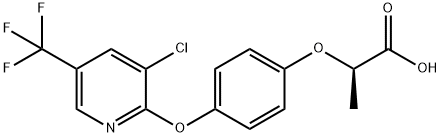
Haloxyfop-P is a post-emergence herbicide, usually formulated as the methyl variant, used to control annual and perennial grass weeds. It has a low water solubility, non-volatile and tends to be non-persistent in soil and water systems. It has a moderate mammalian oral toxicity but there is no evidence of chronic issues such as carcinogenicity, endocrine disruption or neurotoxicity. It is moderately toxic to mammals, birds and fish but slightly less toxic to honeybees, aquatic invertebrates and algae.
Haloxyfop-P is a herbicide for controlling weeds in cassia fields. A pesticide residue in vegetables.
ChEBI: Haloxyfop-P is a 2-(4-{[3-chloro-5-(trifluoromethyl)pyridin-2-yl]oxy}phenoxy)propanoic acid that has R configuration. It is the most active enantiomer of the (racemic) herbicide haloxyfop and is used (particularly as the corresponding methyl and ethoxyethyl ester proherbicides (haloxyfop-P-methyl and haloxyfop-P-etotyl, respectively) to control annual and perrenial grasses in a variety of crops. It has a role as a phenoxy herbicide, an agrochemical and an EC 6.4.1.2 (acetyl-CoA carboxylase) inhibitor. It is a conjugate acid of a haloxyfop-P(1-). It is an enantiomer of a (S)-haloxyfop.
Haloxyfop-P tends to be used and produced as the methyl variant. The commercial production of haloxyfop-P-methyl involves a multi-step synthetic process designed to yield the biologically active R-enantiomer with high optical purity. It begins with the preparation of a substituted hydroquinone, which undergoes etherification with a chiral alkylating agent, typically (R)-2-bromopropionic acid methyl ester, to introduce the stereocentre. This intermediate is then reacted with a halogenated pyridine derivative, such as 3-chloro-2-bromo-5-trifluoromethylpyridine, under controlled conditions to form the key pyridyloxy linkage. The resulting compound is purified and esterified to produce haloxyfop-P-methyl.
Selective, absorbed by roots and foliage. Acetyl CoA carboxylase inhibitor (ACCase) - distrupts fatty acid biosynthesis and lipid formation.