Ethofumesate is a pre- and post-emergence selective herbicide for grasses and broadleaved weed control. It is moderately soluble in water and highly soluble in many organic solvents. It is not considered to be volatile, nor is it usually persistent in soil systems. It is moderately mobile in the environment and so may leach to groundwaters. Ethofumesate has a low to moderate ecotoxicity for many species although there are gaps in data. No serious human health issues have been identified.
Colorless to white crystalline solid.
Commercial formulations include flowable concentrate,
emulsifiable concentrate, and granular products. Mild aromatic odor.
Whitish crystals. Does not
hydrolyze with water at neutral pH.
Ethofumesate is a herbicide.
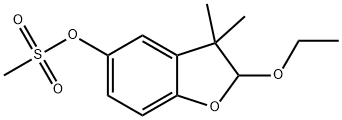
ChEBI: 2-ethoxy-3,3-dimethyl-2,3-dihydro-1-benzofuran-5-yl methanesulfonate is a methanesulfonate ester that is methanesulfonic acid in which the hydrogen of the hydroxy group has been replaced by a 2-ethoxy-3,3-dimethyl-2,3-dihydro-1-benzofuran-5-yl group. It is an ether, a methanesulfonate ester and a member of 1-benzofurans.
Ethofumesate is commercially produced through a multi-step chemical synthesis involving several key reactions. The process typically begins with the reaction of morpholine and isobutanal, followed by a cyclisation step involving benzoquinone to form the benzofuran core structure. This intermediate is then subjected to sulfonation using methylsulfuryl chloride, forming a methanesulfonate ester. The final steps include alcohol-based reactions and purification through crystallization and recrystallization to yield high-purity ethofumesate.
Herbicide: A major use is to control weeds in sugar beet crops.
U.S. Maximum Allowable Residue Levels for
Ethofumesate and its metabolites 2-hydroxy-2,3-dihydro-3,3-dimethyl-5-benzofuranyl
methanesulfonate and
2,3-dihydro-3,3-dimethyl-2-oxo-5-benzofuranyl methanesulfonate
(both calculated as the parent compound)
BATAMIX PROGRESS®; BETANAL®;
ETHOSAT® 500; KEMIRON®; NORTRON®; NC8438®;
POWERTWIN®; PROGRASS®; PROGRESS®;
TANDEM®; TORERO®
Selective, systemic, absorbed through emerging shoots and roots. Inhibition of lipid synthesis.
UN3077 Environmentally hazardous substances,
solid, n.o.s., Hazard class: 9; Labels: 9-Miscellaneous hazardous material, Technical Name Required.
Incompatible with oxidizers (chlorates,
nitrates, peroxides, permanganates, perchlorates, chlorine,
bromine, fluorine, etc.); contact may cause fires or explosions. Keep away from alkaline materials, strong bases,
strong acids, oxoacids, and epoxides
Do not discharge into drains
or sewers. Dispose of waste material as hazardous waste using a licensed disposal contractor to an approved landfill.
Consult with environmental regulatory agencies for guidance on acceptable disposal practices. If allowed,
Incineration with effluent gas scrubbing is recommended.
Containers must be disposed of properly by following package label directions or by contacting your local or federal
environmental control agency, or by contacting your
regional EPA office