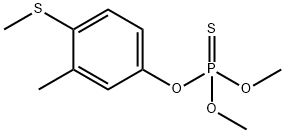
Fenthion is an organothiophosphate insecticide, avicide, and acaricide. Like most other organophosphates, it acts as a cholinesterase inhibitor[1, 2]. It has relatively low toxicity towards humans and mammals and is listed as moderately toxic compound in U.S. Environmental Protection Agency and World Health Organization toxicity class. However, it is highly toxic to birds. It can be used in agriculture and against mosquito larvae in tropical fresh waters[2, 3].
Fenthion is a contact and stomach insecticide, which can be used for the treatment of many sucking, biting pests, especially mosquitoes, fruit flies, stem borers, and Eurygaster cereal bugs. Specially, it is toxic to both the adult and immature forms[larvae] of the mosquitoes. Due to that it has been used extensively in the U.S. for controlling intestinal worms, fenthion no longer has FDA approval due to an excess number of poisoning deaths. Fenthion is available in dust, emulsifiable concentrate, granular, liquid concentrate, spray concentrate, ULV and wettable powder formulations[4].
Fenthion is used for field and post-harvest treatment of various fruits, vegetables, and ornamentals[including sugar cane, rice, field corn, beets, pome and stone fruits, citrus fruits, pistachio, cotton, olives, coffee, cocoa and vines], for mosquito control in water and septic tanks, for pest control in commercial and domestic areas and as an ectoparasiticide in cattle[1, 2,5]. Fenthion is also used for quarantine control of Queensland fruit fly and other fruit flies through post-harvest treatments[dipping, flood sprays and non-recirculating low volume sprays]. It is highly effective in the treatment of various pests including fruit flies, leafhoppers, cereal bugs, stem borers, mosquitoes, animal parasites, mites, aphids, codling moths, and weaverbirds[6].
While it is effective as an insecticide, it is also moderately toxic to mammals, and highly toxic to birds. Based on its high toxicity to birds, fenthion is used in various parts of the world for weaverbird control. Pest control operators have used it to control pigeons around public buildings, as well. Once contacting bird, fenthion can subject to rapid absorption through the skin and killing birds. Acute symptoms of fenthion poisoning in birds include tearing of the eyes, foamy salivation, lack of movement, tremors, congestion of the windpipe, lack of coordination in walking, and an abnormally rapid rate of breathing or difficult breathing. It is usually applied as a paste to roosting areas when utilized for such purposes[6, 7]. Fenthion has also been tested in dogs and cows for possible control of parasites[8].
Fenthion belongs to one of a class of insecticides referred to as organophosphates[1,9]. These chemicals act by interfering with the activities of cholinesterase, an esterase that lyses choline-based esters, several of which serve as neurotransmitters. Thus, it is either of two enzymes that catalyze the hydrolysis of these cholinergic neurotransmitters, such as breaking acetylcholine into choline and acetic acid. These reactions are necessary to allow a cholinergic neuron to return to its resting state after activation. Therefore, it is essential for the proper working of the nervous systems of both humans and insects[10, 11].
Fenthion can provide both acute toxicity and chronic toxicity.
Acute toxicity[12]
It is moderately toxic if ingested, inhaled, or absorbed through the skin. It affects the central nervous, cardiovascular, and respiratory systems, and may irritate eyes and mucous membranes. When inhaled, the first effects may include bloody or runny nose, coughing, chest discomfort, difficult or short breath, and wheezing due to constriction or excess fluid in the bronchial tubes. Skin contact with organophosphates may cause localized sweating and involuntary muscle contractions. Eye contact will cause bleeding, tears, pupil constriction, pain, and blurred vision. Symptoms of acute exposure to organophosphate or cholinesterase-inhibiting compounds may also include the following: dizziness, tremor, nausea, abdominal cramps, sweating, blurred vision, headache, numbness, tingling sensations, incoordination, difficulty breathing or respiratory depression, and slow heartbeat. Very high doses may result in unconsciousness, incontinence, and convulsions or fatality[12].
Chronic toxicity
Carcinogenic effectsThe National Cancer Institute performed carcinogenicity tests on fenthion that indicated that this insecticide might be a carcinogen in male mice. However, no carcinogenic effects were observed in other two-year feeding studies of rats and mice[13].
Reproductive effects-Single injections of 40 or 80 mg/kg of fenthion into the abdominal cavities of pregnant female mice caused poisoning in the developing fetuses, particularly when administered on days 10 through 12 of gestation. There were significantly more abnormalities in the offspring of female mice that had received 40 mg/kg on days 8 or 10 of pregnancy[14, 15].
Teratogenicity effects-Some reduction in fetal weight occurred, but no defects were found in mice that were given intraperitoneal doses of up to 80 mg/kg of fenthion in single day or 3-day periods during the period of gestation in which organs are formed[16].
- Thomson, W. T. 1976. Insecticides, acaricides and avicides. Agricultural Chemicals, Book I. Fresno, CA: Thomson Publications.
- EXTOXNET.[2003]. Pesticide information Profile for Fenthion. Cooperative Extension Offices of Cornell University, Michigan State University, Oregon State University, and University of California at Davis.
- Meister, R.T.[ed.]. 1992. Farm Chemicals Handbook '92. Meister Publishing Company, Willoughby, OH.
- Occupational Health Services, Inc. 1986. Material safety data sheet. Secaucus, NJ: OHS, Inc.
- https://sitem.herts.ac.uk/aeru/ppdb/en/Reports/310.htm
- Tucker, R. and D. G. Crabtree. 1970. Handbook of toxicity of pesticides to wildlife. U.S. Department of Agriculture, Fish and Wildlife Service. Bureau of Sport Fisheries and Wildlife.
- McEwen, F. L. and G. R. Stephenson. 1979. The use and significance of pesticides in the environment. NY: John Wiley and Sons, Inc.
- Hayes, W.J. and E.R. Laws[ed.]. 1990. Handbook of Pesticide Toxicology, Vol. 3, Classes of Pesticides. Academic Press, Inc., NY.
- Sakaguchi, K., Akahori, F., Shirai, M., Masaoka, T., Arishima, K., & Kounenis, G.[1998]. Effect of combined fenthion and cimetidine use in rats on lethality, blood cholinesterase activities, and serum cholinesterase isoenzymes. Veterinary & Human Toxicology, 40(2], 77-82.
- Macqueen, J, and D. Plaut. "A review of clinical applications and methods for cholinesterase. " American Journal of Medical Technology 39.7(1973]: 279-287.
- Corbel, V., Stankiewicz, M., Pennetier, C., Fournier, D., Stojan, J., & Girard, E., et al.[2009]. Evidence for inhibition osnsect and mammalian nervous systems by the insect repellent deet. Bmc Biology, 10(1], 86-86.
- Occupational Health Services, Inc. 1991[Sept. 16]. MSDS for Fenthion. OHS Inc., Secaucus, NJ.
- National Cancer Institute. 1979. Bioassay of fenthion for possible carcinogenicity. Technical report series no. 103. U.S. Department of Health, Education, and Welfare. Publication No.[NIH] 791353. Washington, DC: U.S. Government Printing Office.
- ACGIH. 1986. Documentation of threshold limit values and biological exposure indices. Cincinnati, OH: Publications Office, ACGIH.
- Hayes, W. J. 1982. Pesticides studied in man. Baltimore, MD: Williams and Wilkins.
- Shepard, T. H. 1986. Catalog of teratogenic agents. Fifth edition. Baltimore, MD: The Johns Hopkins University Press.
Fenthion is a colorless oily liquid (technical grade, brown oily
liquid with a mercaptan-like odor).
Fenthion is a colorless liquid (when pure)
with a weak, garlic-like odor. The technical grade is a
yellow-to-brown oil.
Pure fenthion is a colorless liquid. Technical fenthion is a yellow or brown oily liquid with a weak garlic odor. It is insoluble or very sparingly soluble in water, but soluble in all organic solvents, alcohols, ethers, esters, halogenated aromatics, and petroleum ethers. It is grouped by the US EPA under RUP and hence requires handling by qualifi ed, certifi ed, and trained workers. Fenthion is used for the control of sucking and biting pests, i.e., fruit fl ies, stem borers, mosquitoes, and cereal bugs. In mosquitoes, it is toxic to both the adult and immature forms (larvae). The formulations of fenthion include dust, emulsifi able concentrate, granular, liquid concentrate, spray concentrate, ULV, and wettable powder.
Fenthion is an organothiophosphate used as an insecticide. Fenthion is also a potent acaricide.
Insecticide for control of fruit ies, leaf hoppers and cereal bugs. Fenthion is also used as an acaracide.
The production of fenthion involves the esterification of 3-methyl-4-methylthiophenol with dimethyl phosphorochloridothioate. This reaction typically occurs under anhydrous conditions using an acid scavenger such as triethylamine to neutralize the hydrochloric acid byproduct. The process is carried out in an organic solvent like toluene or dichloromethane at controlled temperatures to ensure high yield and purity.
ChEBI: An organic thiophosphate that is O,O-dimethyl hydrogen phosphorothioate in which the hydrogen atom of the hydroxy group is replaced by a 3-methyl-4-(methylsulfanyl)phenyl group. It exhibits acaricidal and insecticidal
activities.
Yellow to tan oily liquid with a slight odor of garlic.
Fenthion may react with strong reducing agents such as hydrides to generate highly toxic and flammable phosphine gas. Partial oxidation by oxidizing agents may result in the release of toxic phosphorus oxides.
Toxic by ingestion, inhalation, and skin
absorption; use may be restricted, cholinesterase
inhibitor. Toxic by skin absorption; questionable
carcinogen.
Fenthion is moderately toxic to mammals, and highly toxic to birds. Exposures to fenthion cause poisoning with symptoms among occupational workers as observed with organophosphate pesticide-induced toxicity. These include, but are not limited to, numbness, tingling sensations, incoordination, headache, dizziness, tremor, nausea, abdominal cramps, sweating, blurred vision, diffi culty breathing or respiratory depression, and slow heart beat. Very high doses may result in unconsciousness, incontinence, and convulsions or fatality. Reports have indicated that exposures to fenthion cause adverse effects on the central and peripheral nervous systems, and the heart of exposed workers.
Fenthion is probably combustible.
Insecticide, Larvicide, Veterinary medicine: Not registered for use in the U.S. Not approved for
use in EU countries. Used in 20 countries including
Australia. There are 23 global suppliers.
B 29493®; BACID®; BAY 29493®;
BAYCID®; BAYER 29493®; BAYER 9007®; BAYER
S-1752®; BAYTEX®; ENTEX®; LEBAYCID®;
MPP®; MPP (pesticide) OMS 2®; PHENTHION®;
PILARTEX®; QUELETOX®; S 1752®; SPOTTON®;
SULFIDOPHOS®; TALODEX®; TIGUVON®
A potential danger to those involved
in the manufacture, formulation, or application of this agricultural chemical and pesticide; insecticide
If this chemical gets into the eyes, remove anycontact lenses at once and irrigate immediately for at least15 min, occasionally lifting upper and lower lids. Seek medical attention immediately. If this chemical contacts theskin, remove contaminated clothing and wash immediatelywith soap and water. Speed in removing material from skinis of extreme importance. Shampoo hair promptly if contaminated. Seek medical attention immediately. If thischemical has been inhaled, remove from exposure, beginrescue breathing (using universal precautions, includingresuscitation mask) if breathing has stopped and CPR ifheart action has stopped. Transfer promptly to a medicalfacility. When this chemical has been swallowed, get medical attention. Give large quantities of water and inducevomiting. Do not make an unconscious person vomit. Ifexposure and/or symptoms have occurred, the person shouldbe under medical observation for several days, as somesymptoms may be delayed.
Biological. From the first-order biotic and abiotic rate constants of fenthion in estuarine water and sediment/water systems, the estimated biodegradation half-lives were 22.4 and 3.9–14.5 days, respectively (Walker et al., 1988).
Surface Water. In estuarine water, the half-life of fenthion was 4.6 days (Lacorte et al., 1995).
Plant. In plants, fenthion oxidizes to the mesulfenfos and sulfone which further degrades to the sulfone phosphate before undergoing hydrolysis (Hartley and Kidd, 1987).
Photolytic. Fenthion was oxidized to the corresponding sulfoxide and trace amounts (<5% yield) of sulfone when sorbed on soil and exposed to sunlight. The photosensitized oxidation was probably due to the presence of singlet oxygen. The degradation rate was higher in soils containing the lowest organic carbon (Gohre and Miller, 1986).
Chemical/Physical. Stable at temperatures below 210°C (Worthing and Hance, 1991). Emits very toxic fumes of phosphorus and sulfur oxides when heated to decomposition (Sax and Lewis, 1987; Lewis, 1990).
The major route of fenthion metabolism is by oxidation to the sulfoxide
which has a higher insecticidal activity than the parent compound. The
subsequent oxidation of the sulfoxide to fenthion sulfone, the biological
activity of which is considerably lower, is slow in plants but of major
significance in animals. An additional route of bioactivation is through
oxidative desulfuration to form fenoxon and, in all, five oxidative
metabolites (fenthion sulfoxide, fenthon sulfone, fenoxon, fenoxon
sulfoxide and fenoxon sulfone) have been detected in most biological
systems. Hydrolysis, in contrast to most insecticidal phosphorothioates,
appears to proceed via direct hydrolysis of fenthion rather than its oxon.
The phenolic leaving group (3-methyl-4-thiomethylphenol) is identical to
that of fenamiphos and although no studies have described the fate of the
phenolic moiety for fenthion, it is likely that it will be metabolised by
similar routes to those described for fenamiphos.
: Color Code—Blue: Health Hazard/Poison: Storein a secure poison location. Prior to working with thischemical you should be trained on its proper handling andstorage. Store in tightly closed containers in a cool, wellventilated area away from oxidizers, alkalies and alkalinepesticides. A regulated, marked area should be establishedwhere this chemical is handled, used, or stored in compliance with OSHA Standard 1910.1045.
UN3018 Organophosphorus pesticides, liquid,
toxic, Hazard Class: 6.1; Labels: 6.1-Poisonous materials.
UN2810 Toxic liquids, organic, n.o.s., Hazard Class: 6.1;
Labels: 6.1-Poisonous materials, Technical Name Required.
Acute oral LD50 for rats: ca. 250 mg /kg
Fenthion is stable in light, stable to acid and moderately stable to alkaline
conditions. The DT50s at pH 4, 7 and 9 were 223, 151 and 151 days
respectively (PM).
The effect of the cuticular waxes of fruit upon the photodegradation of
fenthion was studied by Cabras et al. (1997). Waxes were extracted with
acetone and the fenthion added to the solution. The wax plus fenthion
was applied as a film which was irradiated by natural sunlight. The
analysis of fenthion and its metabolites was by GLC-FID (Cabras and
Plumitallo, 1991). The potential metabolites synthesised were fenthion
sulfoxide (2), fenthion sulfone (3), fenoxon (4), fenoxon sulfoxide (5) and
fenoxon sulfone (6). Waxes from different fruits affected the decay rate,
with wax from oranges and nectarines increasing the rate of decomposition
but cuticular wax from olives retarding the rate. In all cases the
products of photodegradation were fentluon sulfoxide (2), which
steadily increased with time, and fenthion sulfone (3), which remained at
a low but detectable level throughout the experiment. Minelli et al. (1996)
exposed fenthion in glass jars to natural sunlight and analysed the photodegradation
products by GLC-FID. The major product was fenthion
sulfoxide (2) which very slowly degraded to the sulfone (3). This in turn
was even more slowly photo-oxidised to fenoxon sulfone (6). The routes
for the photodegradation of fenthion are shown in Scheme 1.
Incompatible with oxidizers (chlorates,
nitrates, peroxides, permanganates, perchlorates, chlorine,
bromine, fluorine, etc.); contact may cause fires or explosions. Keep away from alkaline materials, strong bases,
strong acids, oxoacids, epoxides, alkaline insecticides.
Organothiophosphates are susceptible to formation of
highly toxic and flammable phosphine gas in the presence
of strong reducing agents such as hydrideds and active
metals. Partial oxidation by oxidizing agents may result in
the release of toxic phosphorus oxides.
Hydrolysis and landfill for
small quantities; incineration with flue gas scrubbing for
large amounts. In accordance with 40CFR165, follow
recommendations for the disposal of pesticides and pesticide containers. Must be disposed properly by following
package label directions or by contacting your local or federal environmental control agency, or by contacting your
regional EPA office
Insecticide; Veterinary substance; Avicide