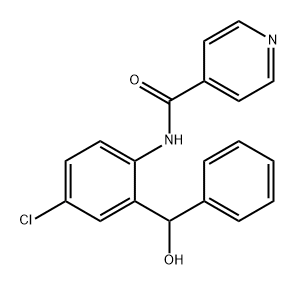
Inabenfide (N-[4-chloro-2-(hydroxybenzyl)phenyl]pyridine-4-carboxamide) is a plant growth retardant that inhibits gibberellin synthesis in rice plants, exhibiting strong selective lodging resistance. After application, the number of grains per panicle decreases, but the grain maturity rate increases, leading to an increase in actual yield. Therefore, inabenfide is widely used in rice production.
Inabenfide is prepared as follows: isonicotinic acid is used as the starting material, and after chlorination by phthalic acid, it is reacted with 2-amino-5-chlorobenzophenone at a controlled temperature. After obtaining the intermediate ketone, the reduction reaction is carried out, that is, the final product inabenfide. Specific operation steps 13.5 g (0.1 moles) of isonicotinic acid was placed in a 260 ml three-necked bottle, 80 g of organic solvent was added, and 13.1 g (0.1 moles) of thionyl chloride was added dropwise at a certain temperature. After the dropwise addition, stirring was continued for 2 to 3 hours, and then 23.2 g (0.1 mol) of 2-amino-5-chloro-benzophenone dissolved in 40 g of organic solvent was added dropwise. After stirring the reaction, the system changed from a suspension to a clear liquid and gradually precipitated a solid, continued stirring for 2~4 hours, cooled, diluted with water, filtered, washed with water to obtain yellow needle-like crystals with a melting point of 154C. Dissolve the above crystals in 120 ml of methanol, at a certain temperature, add a certain amount of reducing agent in batches, stirring for 2~4 hours. Heat, and then stir the reaction work hours. Cooling, filtration, washing with methanol and water in turn, drying, yielding 30.8 g of light yellow solid, 95% yield, melting point 208~209 . After recrystallization of the product, melting point 220~222.
In rats, inabenfide is mainly hydroxylated on the
phenyl ring which is not substituted by a chlorine atom
through epoxidation. Oxidation of the benzyl alcohol
gives benzophenone. The other hydroxylation is the
substitution of the chlorine with hydroxyl of the other phenyl ring possessing a chlorine atom. Also,
hydrolysis of the amide bond resulting in the
corresponding aniline and N-oxidation of the pyridine
nitrogen can be observed.