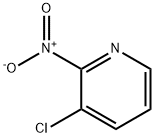
Literature reports that 3-chloro-2-nitropyridine can be prepared from 3-amino-2-nitropyridine via a continuous flow reaction.
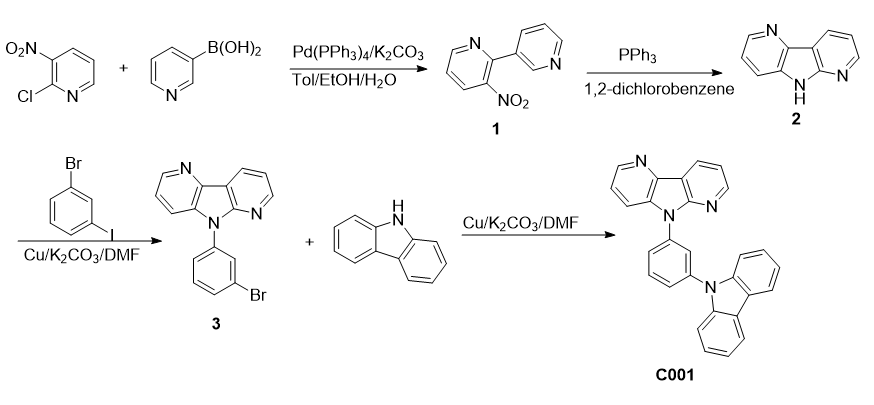
3-chloro-2-nitropyridine can be used to prepare a diazacarbazole derivative. Carbazole compounds possess sufficiently high triplet states, good hole transport capabilities, photochemical stability, high carrier mobility, strong absorption in the ultraviolet range with a band gap of approximately 3.20 eV, and valuable blue light emission. Substitution modification at the 3, 6, 9-positions or other carbon atoms yields a variety of highly efficient luminescent materials. Furthermore, luminescent materials obtained by bonding electron-deficient carbazole-like groups (diazacarbazole groups) with different groups can also achieve triplet states and tunable molecular orbital energy levels. This fundamentally enables efficient carrier recombination in organic electroluminescent devices, resulting in highly efficient and energy-saving OLED devices. It can also be widely applied in the field of organic electroluminescence.