Synthesis
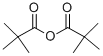
Currently, the synthesis of trimethylacetic anhydride from terpentine is mainly achieved through dehydrating agents or by the action of acetic anhydride. This method requires the use of dehydrating agents that cause severe environmental pollution, and the production process is long, involves many steps, requires high investment in equipment and infrastructure, and demands high corrosion resistance from the equipment. If acetic anhydride is used to induce an exchange dehydration reaction, the reaction time is also relatively long. Therefore, a systematic study of the preparation process of trimethylacetic anhydride is of great significance. The synthesis reaction formula of trimethylacetic anhydride is shown in the figure below:

Figure 1 Synthesis reaction formula of trimethylacetic anhydride
Mechanism of Hydrolysis
The acid hydrolysis of trimethylacetic anhydride follows an A-2 mechanism in both water and aqueous dioxane and is slower than that of acetic anhydride. acetic anhydride also follows an A-2 mechanism.

These observations suggest that the acid hydrolysis of Perchloric, sulfuric, and hydrochloric acid catalyze hydrolysis to different extents, and plots of the logarithms of the rate constants against log [H+] or Ho are curved. These reactions are likely to involve a bimolecular attack by water molecules on the anhydride or its conjugate acid, as the methyl group is expected to hinder the incoming nucleophile through steric hindrance and, possibly, through inductive effects[1].
Description
Trimethylacetic anhydride is a pivalic acid derivative that is used in organic synthesis. The compound's reaction mechanism is believed to be the formation of an alkanoic acid, which reacts with a hydroxyl group to form an anhydride. Trimethyl acetic anhydride has been shown to have pharmacokinetic properties and can be used as a nonsteroidal anti-inflammatory drug. This compound has also been found to have a matrix effect on crystalline cellulose and is capable of forming nitrogen-containing carboxylic acids.
Chemical Properties
clear colourless liquid
Uses
Trimethylacetic anhydride was used:
- in solid-phase oligonucleotide synthesis
- in kinetic resolution of racemic 2-hydroxy-γ-butyrolactones with diphenylacetic acid
- as acylation and esterification reagent for anilines
- as acylation and esterification reagent for phenols
Uses
A metabolite of a double prodrug (6-dGCV-DPiv
Application
Trimethylacetic anhydride (TMA) as a new reagent for efficient histone derivatization, which is a requirement for bottom-up proteomic hPTM analysis. TMA can derivatize unmodified amine groups of lysine residues and amine groups generated at peptide N-termini by trypsin digestion. It afforded over 98% and 99% labelling efficiencies for histones H4 and H3 respectively, thereby enabling accurate quantification of the peptide forms[2].
Flammability and Explosibility
Not classified
References
[1] C. A. Bunton, & J. H. F. (1965). The Hydrolysis of Carboxylic Anhydrides. V.1,2 The Acid Hydrolysis of Acetic and Trimethylacetic Anhydride. Journal of Organic Chemistry, 30 5, 1365–1371. https://doi.org/
10.1021/jo01016a006[2] Hana Kuchaříková. (2021). Trimethylacetic Anhydride-Based Derivatization Facilitates Quantification of Histone Marks at the MS1 Level. ACS Applied Nano Materials, 100114. https://doi.org/
10.1016/j.mcpro.2021.100114