Chemical Properties
Colorless liquid
Uses
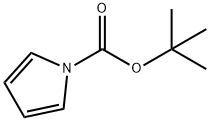
N-Boc-pyrrole was used in the synthesis of 1-(
tert-butoxycarbonyl)-1
H-pyrrol-2-ylboronic acid by treating with
n-BuLi and subsequent reaction with trimethyl borate.
It may be used as starting material in the synthesis of the following:
- tropane drivatives
- N-boc-2-(4-methoxyphenyl)pyrrole
- N-boc-pyrrol-2-ylboronic acid
Uses
Pyrrole-1-carboxylic Acid tert-Butyl Ester is an intermediate in the synthesis of pyrrole derived anti-cancer Agent.
Synthesis Reference(s)
The Journal of Organic Chemistry, 31, p. 764, 1966
DOI: 10.1021/jo01341a027
General Description
N-Boc-pyrrole is an
N-protected pyrrole. It undergoes Diels–Alder reaction with enantiomerically pure allene-1,3-dicarboxylates to form
endo-adducts with retention in configurations at two newly generated stereogenic centers. It also undergoes cyclopropanation with methyl phenyldiazoacetate to form both monocyclopropane and dicyclopropane. Its Ir-catalyzed C-H borylation followed by cross coupling with 3-chlorothiophene to form biheterocycle has been reported.
Synthesis
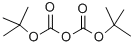
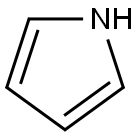
General procedure for the synthesis of tert-butyl 1-pyrrolecarboxylate from pyrrole and di-tert-butyl dicarbonate: di-tert-butyl dicarbonate (Boc2O, 9.8 g, 44.7 mmol) and triethylamine (TEA, 6.3 mL, 44.7 mmol) were added sequentially to a solution of pyrrole (3.0 g, 29.8 mmol) in dichloromethane (DCM, 15 mL). The reaction mixture was stirred at room temperature for 2 hours. Upon completion of the reaction, extraction was performed with dichloromethane (2 x 400 mL) and water (400 mL). The organic layers were combined, dried over anhydrous magnesium sulfate (MgSO4) and concentrated under reduced pressure to afford tert-butyl 1-pyrrolecarboxylate (26) as a white solid (7.5 g). Yield: 94%; 1H NMR (300 MHz, CDCl3) δ (ppm): 7.26 (s, 2H), 7.24 (t, J=2.4 Hz, 1H), 6.22 (t, J=2.4 Hz, 1H), 1.60 (d, J=11.7 Hz, 9H); ESI-MS [M+H]+=169.0.
References
[1] European Journal of Organic Chemistry, 2005, # 11, p. 2207 - 2212
[2] Angewandte Chemie - International Edition, 2015, vol. 54, # 52, p. 15739 - 15743
[3] Angew. Chem., 2015, vol. 127, # 52, p. 15965 - 15969,5
[4] European Journal of Medicinal Chemistry, 2011, vol. 46, # 4, p. 1153 - 1164
[5] Medicinal Chemistry, 2018, vol. 14, # 5, p. 485 - 494