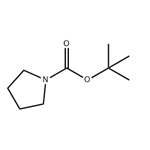
Chemical Properties
liquid
Uses
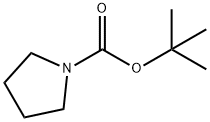
N-Boc-pyrrolidine may be used in the synthesis of the following:
- 2-aryl-N-boc-pyrrolidines
- scalemic 2-pyrrolidinylcuprates
- 2-alkenyl-N-Boc-pyrrolidines
- 1-deoxycastanospermine
- methylphenidate analogues
- (+)-elaeokanine A
Uses
1-Boc-pyrrolidine is a boc-protected cyclic amine used as a building block in the preparation of diastereomers by usually undergoing α'-lithiations and electrophilic substitution reactions.
General Description
N-Boc-pyrrolidine is an
N-substituted pyrrolidine. It is reported that the reactivity of
N-Boc-pyrrolidine towards C-H insertion reaction is 2000 times more than cyclohexane. It undergoes α-arylation in the presence of a palladium catalyst with high enantioselectivity.
Synthesis
The general procedure for the synthesis of 1-Boc-tetrandrine from tetrandrine and di-tert-butyl dicarbonate is as follows: the synthesis was carried out by a modified literature method (omitting the Sparteine chiral ligand), as specified in J. Am. Chem. Soc. 1994, 116, 3231.The steps are as follows:
A) Preparation of Boc-protected pyrrolidines
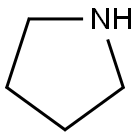
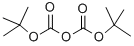
Triethylamine (TEA, 15.6 g, 0.15 mol) was slowly added to a dichloromethane (DCM, 150 mL) solution of pyrrolidine (10.0 g, 0.14 mol) in stirring at 0 °C. Subsequently, di-tert-butyl dicarbonate ((Boc)2O, 30.6 g, 0.14 mol) was added, and the reaction mixture was stirred at room temperature for 1 hour. The progress of the reaction was monitored by thin layer chromatography (TLC) to confirm complete pyrrolidine consumption. Upon completion of the reaction, the reaction mixture was washed sequentially with 1 M aqueous hydrochloric acid (100 mL) and brine, and the organic phase was dried over anhydrous sodium sulfate (Na2SO4), filtered, and concentrated under reduced pressure to afford the colorless, oily product 1-Boc-tetrandrine (24.0 g, 100%), which could be used in the subsequent steps without further purification.
References
[1] Tetrahedron Letters, 2008, vol. 49, # 16, p. 2527 - 2532
[2] Patent: WO2013/102242, 2013, A1. Location in patent: Page/Page column 94; 95
[3] Tetrahedron Letters, 2007, vol. 48, # 47, p. 8318 - 8322
[4] Journal of the American Chemical Society, 2017, vol. 139, # 24, p. 8267 - 8276
[5] Synthesis, 2001, # 4, p. 550 - 552