Chemical Properties
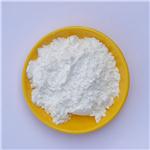
White to pale yellow lumps
Uses
Starting material for preparing BOC-azide, a reagent to introduce the BOC amino protection.
Uses
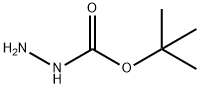
tert-Butyl carbazate is used in a palladium-catalyzed cross-coupling with vinyl halides to prepare N-Boc-N-alkenylhydrazines. It is utilized in solid phase peptide synthesis and in the optical purity determination of alfa-amino aldehyde. It reacts with aldehydes to get hydrazones, which finds application as an intermediate in the synthesis of HIV-1 protease inhibitors. In addition to this, it is used as a starting material for the preparation of BOC-azide, sulfonic and carboxylic hydrazides.
Synthesis Reference(s)
Journal of the American Chemical Society, 82, p. 2725, 1960
DOI: 10.1021/ja01496a018Chemical and Pharmaceutical Bulletin, 18, p. 217, 1970
DOI: 10.1248/cpb.18.217
Synthesis
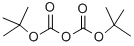
General procedure for the synthesis of tert-butyl hydrazinecarboxylate from di-tert-butyl dicarbonate: Hydrazine hydrate (113 mg, 2.26 mmol, 2.26 eq.) was dissolved in isopropanol (IPA, 5 mL) and the solution was cooled to 0 °C. Subsequently, di-tert-butyl dicarbonate (174 mg, 1 mmol, 1 eq.) dissolved in isopropanol (IPA, 1 mL) was added dropwise. The reaction mixture was stirred at 0 °C for 2 hours. After completion of the reaction, the solvent was removed by rotary evaporator. The residue was dissolved in dichloromethane (DCM) and dried with anhydrous magnesium sulfate (MgSO4). After drying, the desiccant was removed by filtration and the solvent was again removed by rotary evaporator to give tert-butylhydrazine carboxylate (10) as a white semi-solid (128 mg, 97% yield). The product was confirmed by nuclear magnetic resonance hydrogen spectrum (1H NMR, 300 MHz, CDCl3): δ 6.73 (s, 1H), 3.83 (s, 2H), 1.46 (s, 9H); nuclear magnetic resonance carbon spectrum (13C NMR, 75 MHz, CDCl3): δ 158.2, 80.1, 28.2.
Purification Methods
Distil it in a Claisen flask with a water or oil bath at ca 80o. After a couple of drops have distilled, the carbazate is collected as an oil which solidifies to a snow white solid. It can be crystallised with 90% recovery from a 1:1 mixture of pet ether (b 30-60o) and pet ether (b 60-70o). [Carpino et al. Org Synth Coll Vol V 166 1973, Caprino et al. Org Synth 44 20 1964, Beilstein 3 IV 175.]
References
[1] European Journal of Medicinal Chemistry, 2012, vol. 54, p. 33 - 41
[2] Tetrahedron Letters, 2015, vol. 56, # 48, p. 6653 - 6655
[3] Journal of Inorganic Biochemistry, 2013, vol. 127, p. 188 - 202
[4] Organic and Biomolecular Chemistry, 2017, vol. 15, # 43, p. 9071 - 9076
[5] Journal of Materials Chemistry B, 2017, vol. 5, # 19, p. 3565 - 3571