Uses
Reactant for synthesis of:
- Non-nucleoside inhibitors of HCV polymerase NS5B
- Neuropeptide Y1 receptor antagonists
- Alkenylcarboxylates from Horner-Wadsworth-Emmons reactions
Reactant for:
- Enantioselective transfer hydrogenation for preparation of the C7-C14 fragment of ulapualide A
- Intramolecular Michael reactions
- Olefination of peptidyl aldehydes with stabilized ylides
Application
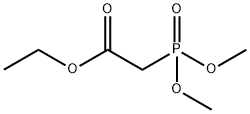
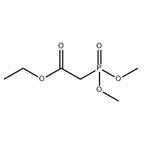
Ethyl dimethylphosphonoacetate could prepare a temporary plugging agent with hydroxyethylpyrrolidone and ethyl perfluorobutyl ether. The temporary plugging agent is useful for oil-water wells.
reaction suitability
reaction type: C-C Bond Formation
Synthesis
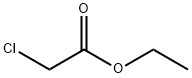
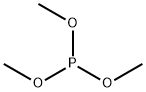
The general procedure for the synthesis of ethyl dimethylphosphonoacetate from ethyl chloroacetate and trimethoxyphosphorus is as follows: a dry and clean 500 mL coil was heated to 150 °C. Take 1000g (0.7 eq., 8.16 mol) of ethyl chloroacetate (boiling point 142~145°C at standard atmospheric pressure) in reaction flask A and dilute it by adding 4000g of toluene. Another 1417g (1.0 eq., 11.42mol) of trimethoxyphosphine (boiling point at 112°C under standard atmospheric pressure) was placed in reaction vial B, and 3583g of toluene was added for dilution. After the coil temperature was stabilized, pump A (mixed solution of ethyl chloroacetate and toluene) and pump B (mixed solution of trimethoxyphosphine and toluene) were activated, both at a flow rate of 25.0 g/min. The residence time of the reactants in the reactor was 10 min, and the reaction pressure was maintained at 0.5~2.0 MPa. Upon completion of the reaction, the discharge port was directly connected to the thin-film evaporation device, and the evaporation pressure was controlled to 4~ 10×102 Pa, and the temperature was 95~105°C. Finally, 1344 g of ethyl dimethylphosphonoacetate (boiling point of 110~112°C, 466 Pa) was obtained with a yield of 84%.
References
[1] Patent: CN107163079, 2017, A. Location in patent: Paragraph 0068; 0069; 0070; 0071
[2] Bulletin de la Societe Chimique de France, 1965, p. 1925 - 1930
[3] Tetrahedron Letters, 1999, vol. 40, # 8, p. 1455 - 1458