Chemical Properties
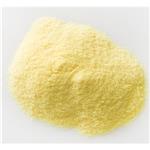
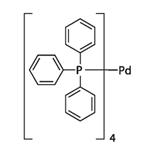
Tetrakis(triphenylphosphine)palladium, commonly abbreviated as Pd(PPh₃)₄ or PdP₄, is a bright yellow crystalline solid that gradually darkens to brown upon exposure to air. It is sparingly soluble in saturated hydrocarbons but readily soluble in a variety of organic solvents, including chloroform (CHCl₃), dimethoxyethane (DME), tetrahydrofuran (THF), dimethylformamide (DMF), benzene, and toluene.
Uses
Tetrakis(triphenylphosphine)palladium(0) is widely used as a catalyst for palladium-catalyzed coupling reactions.
Uses
Pd(PPh3)4 is widely used as a catalyst for palladium-catalyzed coupling reactions. Prominent applications include the Heck reaction, Suzuki coupling, Stille coupling, Sonogashira coupling, and Negishi coupling.
Application
Palladium-Catalyzed Three-Component Reaction for the Synthesis of Imidazolidinones.
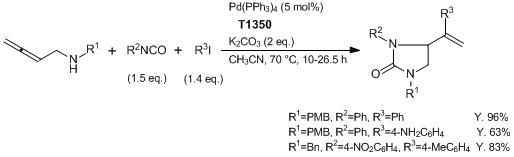
Once the Schlenk tube containing K2CO3 (55 mg, 0.40 mmol) is flamed, dried, and filled with argon, Tetrakis(triphenylphosphine)palladium (12 mg, 0.010 mmol), PMB-protected 2,3-allenylamine (37 mg, 0.20 mmol), iodobenzene (58 mg, 0.28 mmol), phenyl isocyanate (36 mg, 0.30 mmol), and CH3CN (4 mL) are added sequentially. The resulting solution is heated to and stirred at 70°C. When the reaction is completed as monitored by TLC, the solvent is evaporated under reduced pressure, and the residue is purified by chromatography on silica gel (petroleum ether : ethyl acetate = 7:1) to afford the corresponding imidazolidione (72 mg, Y. 96%) as an oil.
Preparation
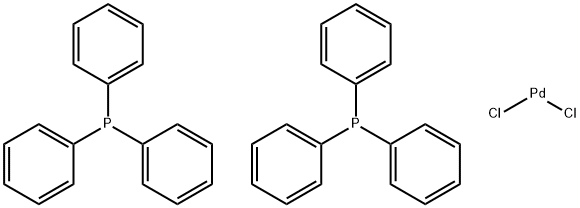
It can be prepared by reduction of PdCl₂(PPh₃)₂ with hydrazine or by reaction of Pd₂(dba)₃ with triphenylphosphine (PPh₃).
Reactions
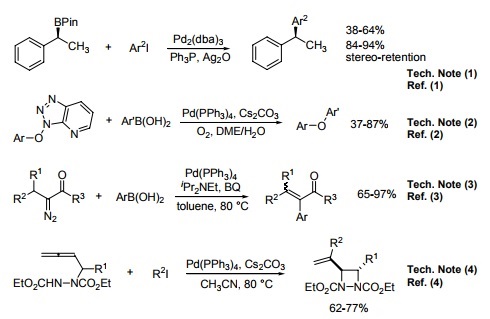
- Catalyst for Suzuki coupling of chiral secondary organoboronic esters.
- Palladium-catalyzed SNAr reactions for the synthesis of heteroaryl ethers.
- Catalyst for cross-coupling of a-diazocarbonyl compouns with arylboronic acids.
- Diastereoselective synthesis of trans-1,2-diazetidines.
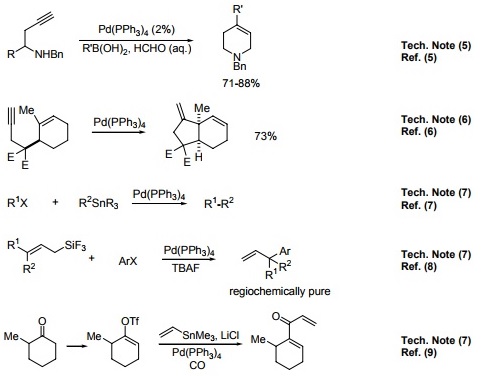
- Palladium-catalyzed alkynyl iminium ion cyclization.
- Widely used reagent in a variety of transformations including Heck arylation, enyne and diyne cycloisomerization.
- Catalysts for cross-coupling.
Flammability and Explosibility
Non flammable
reaction suitability
reagent type: catalyst
reaction type: Cross Couplings
storage
Tetrakis(triphenylphosphine)palladium(0) is sensitive to light and air and should be stored under an inert atmosphere, protected from light. During use, it may be handled in air for short periods; however, it is preferable to perform the procedure under a nitrogen or argon atmosphere using vacuum-line techniques.
Purification Methods
The palladium complex is recrystallised from EtOH. It should not be heated excessively as it dissociates to Pd(PPh3)3 and PdPh3 and then further to Pd(PPh3)2 and PPh3. It is also air sensitive as PPh3 is oxidized to PPh3O. It is stable only for short periods because on exposure to heat or air it turns from yellow to orange and dissociates in solution so the solutions should be used directly. However it can always be prepared freshly by mixing Pd(NO3)2 (2mmols) and PPh3(2mmols) in hot *C6H6 when vigorous evolution of nitric oxide occurs and a solid mass separates. This is collected and crystallised from EtOH. Its cryoscopic constant in *C6H6 (at 0.601g/20mL) corresponds to M 1156 [Malatesta & Angoletti J Chem Soc 1186 1957]. It is a useful catalyst for Suzuki coupling reactions [Trost Tetrahedron 33 2615 1977]. [Beilstein 16 IV 954.] This palladium catalyst bound to a polymer support (~0.06mmol/g) is also commercially available [cf Fenger & LeDrain Tetrahedron Lett 39 4287 1998]. [Beilstein 16 IV 954.]