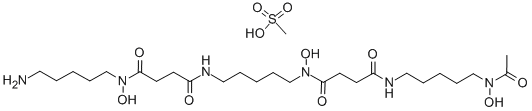
Description
Deferoxamine is a bacterial siderophore that chelates iron. It is used to experimentally inhibit iron-
dependent prolyl hydroxylases (EC
50 = 17.8 μM), thus preventing the degradation of isoforms of hypoxia inducible factor during normoxia. Deferoxamine has applications in diseases that are characterized by high levels of circulating iron, such as thalassemia major.
References
[1] W L STEINMETZ T O O M R Glick. Modified aca method for determination of iron chelated by deferoxamine and other chelators.[J]. Clinical chemistry, 1980, 26 11: 1593-1597.
[2] JIMMY R. THERIAULT . Discovery of a new molecular probe ML228: An activator of the hypoxia inducible factor (HIF) pathway[J]. Bioorganic & Medicinal Chemistry Letters, 2012, 22 1: Pages 76-81. DOI:
10.1016/j.bmcl.2011.11.077[3] PANU JAAKKOLA. Targeting of HIF-α to the von Hippel-Lindau Ubiquitylation Complex by O2-Regulated Prolyl Hydroxylation[J]. Science, 2001, 292 5516. DOI:
10.1126/science.1059796[4] K. SANDAU. Regulation of the Hypoxia-inducible Factor 1α by the Inflammatory Mediators Nitric Oxide and Tumor Necrosis Factor-α in Contrast to Desferroxamine and Phenylarsine Oxide*[J]. The Journal of Biological Chemistry, 2001, 120 1: 39805-39811. DOI:
10.1074/jbc.m107689200[5] NEUFELD E J. Update on iron chelators in thalassemia.[J]. Hematology. American Society of Hematology. Education Program, 2010: 451-455. DOI:
10.1182/asheducation-2010.1.451[6] JOSEPH M. HENDRICKS. Identification of structurally diverse FSP1 inhibitors that sensitize cancer cells to ferroptosis[J]. bioRxiv: the preprint server for biology, 2022, 6 1. DOI:
10.1101/2022.12.14.520445[7] FENGXIANG WANG . PALP: A rapid imaging technique for stratifying ferroptosis sensitivity in normal and tumor tissues in situ[J]. Cell Chemical Biology, 2022, 29 1: Pages 157-170.e6. DOI:
10.1016/j.chembiol.2021.11.001[8] DAVID A. ARMENTA . Ferroptosis inhibition by lysosome-dependent catabolism of extracellular protein[J]. Cell Chemical Biology, 2022, 29 11: Pages 1588-1600.e7. DOI:
10.1016/j.chembiol.2022.10.006[9] ALEXANDER BEATTY. Ferroptotic cell death triggered by conjugated linolenic acids is mediated by ACSL1.[J]. ACS Combinatorial Science, 2021: 2244. DOI:
10.1038/s41467-021-22471-y[10] WANLU DU. Lysosomal Zn2+ release triggers rapid, mitochondria-mediated, non-apoptotic cell death in metastatic melanoma.[J]. ACS Applied Polymer Materials, 2021: 109848. DOI:
10.1016/j.celrep.2021.109848[11] PANDIAN NAGAKANNAN . Cathepsin B is an executioner of ferroptosis[J]. Biochimica et biophysica acta. Molecular cell research, 2021, 1868 3: Article 118928. DOI:
10.1016/j.bbamcr.2020.118928[12] DANIEL M. KREMER. GOT1 Inhibition Primes Pancreatic Cancer for Ferroptosis through the Autophagic Release of Labile Iron[J]. bioRxiv: the preprint server for biology, 2020, 8 1. DOI:
10.1101/2020.02.28.970228[13] KIRILL BERSUKER. The CoQ oxidoreductase FSP1 acts parallel to GPX4 to inhibit ferroptosis[J]. Nature, 2019, 575 7784: 688-692. DOI:
10.1038/s41586-019-1705-2[14] JENNIFER YINUO CAO. A Genome-wide Haploid Genetic Screen Identifies Regulators of Glutathione Abundance and Ferroptosis Sensitivity.[J]. Cell reports, 2019: 1544-1556.e8. DOI:
10.1016/j.celrep.2019.01.043[15] ANAGHA SEN. MicroRNA-138 regulates hypoxia-induced endothelial cell dysfunction by targeting S100A1.[J]. PLoS ONE, 2013: e78684. DOI:
10.1371/journal.pone.0078684