Uses
Probenazole can be used in agricultural use and biological study of preparation of nicotinamide compounds containing chiral oxazoline and application thereof as agricultural antimicrobial agent.
Uses
Probenazole is used for the control of rice blast and bacterial
diseases in paddy rice.
Definition
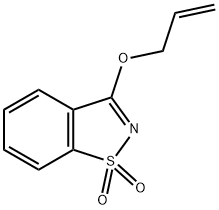
ChEBI: Probenazole is a member of the class of 1,2-benzothiazoles that is 1,2-benzothiazole 1,1-dioxide substituted at position 3 by an allyloxy group. A fungicide used to control rice blast. It has a role as a plant activator and an antifungal agrochemical. It is a 1,2-benzisothiazole, an aromatic ether, a sulfone and a benzothiazole fungicide. It is functionally related to a saccharin.
Production Methods
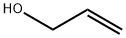
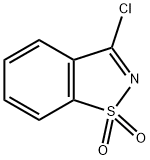
Probenazole is industrially produced starting from saccharin (1,2-benzisothiazolin-3-one 1,1-dioxide). The key steps involve chlorination of saccharin with thionyl chloride in the presence of catalysts like dioxane and DMF to form saccharin chloride (pseudosaccharyl chloride). This intermediate is then concentrated and undergoes etherification with allyl alcohol in dichloromethane (or similar solvent) to introduce the allyloxy group at the 3-position. The resulting crude probenazole is purified through pH adjustment, washing, drying, and grinding (or milling) to yield the final technical-grade product suitable for formulation.
Mechanism of action
Induces systemic acquired resistence - plant defense activator
Metabolic pathway
Probenazole is metabolised readily in plants by hydrolytic ring opening
followed by a cyclisation-induced dealkylation to form saccharin which
is N-glucosylated. Saccharin may be the active metabolite of probenazole.
No information on the fate of probenazole in soil or animals could
be located.
Metabolism
Probenazole is taken up by the rice plants after spray or paddy application and distributed
throughout the plants as parent compound or as one of its
metabolites . The main metabolites of probenazole
in rice are 2-sulfamoyl-allyl-benzoate, saccharin, and N-β-
D-glucopyranosylsaccharin (37).
Degradation
Probenazole is a stable compound but it is subject to hydrolysis.