Description
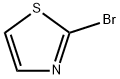
It is usually used as the intermediate or raw material to produce various products in the organic synthesis and pharmaceutical industry, such as 2-acetylthiazole, antibiotics, and anticholinergic drugs. Specifically, this chemical can act as the raw material to produce camalexin through reaction with indolylmagnesium iodide.
1 Moreover, this substance has been selected as the reactant to prepare the thiazole Grignard reagents and thiazolyllithium compounds, which can be converted into thiazole-2-carboxylic acid via a halogen-metal exchange reaction.
2, 3 In addition, 2-bromothiazole has been used to synthesize N-aryl aminothiazoles, which are found to function as the inhibitors of cyclin-dependent kinases.
4 Besides, this compound may be involved in the synthesis of ethynylthiazoles that exhibits a desirable anti-inflammatory activity.
5
Referrence
- Ayer, W. A.; Craw, P. A.; Ma, Y. T.; Miao, S. C., SYNTHESIS OF CAMALEXIN AND RELATED PHYTOALEXINS. Tetrahedron 1992, 48, 2919-2924.
- Kurkjy, R. P.; Brown, E. V., THE PREPARATION OF THIAZOLE GRIGNARD REAGENTS AND THIAZOLYLLITHIUM COMPOUNDS. J. Am. Chem. Soc. 1952, 74, 6260-6262.
- Beyerman, H. C.; Berben, P. H.; Bontekoe, J. S., THE SYNTHESIS OF THIAZOLE-2-CARBOXYLIC AND OF THIAZOLE-5-CARBOXYLIC ACID VIA A HALOGEN-METAL EXCHANGE REACTION. Recl. Trav. Chim. Pays-Bas-J. Roy. Neth. Chem. Soc. 1954, 73, 325-332.
- Misra, R. N.; Xiao, H. Y.; Williams, D. K.; Kim, K. S.; Lu, S. F.; Keller, K. A.; Mulheron, J. G.; Batorsky, R.; Tokarski, J. S.; Sack, J. S.; Kimball, D.; Lee, F. Y.; Webster, K. R., Synthesis and biological activity of N-aryl-2-aminothiazoles: potent pan inhibitors of cyclin-dependent kinases. Bioorg. Med. Chem. Lett. 2004, 14, 2973-2977.
- Geronikaki, A.; Vasilevsky, S.; Hadjipavlou-Litina, D.; Lagunin, A.; Poroikov, B. V., Synthesis and anti-inflammatory activity of ethynylthiazoles. Khim. Geterotsiklicheskikh Soedin. 2006, 769-774.
Chemical Properties
Colourless Liquid
Uses
2-Bromothiazole, is intended used for research purpose only. It is also used as Aryl halide which are used to N-arylate 5- and 7-azaindoles. Copper-catalyzed cyanation provides 2-cyanothiazole
Uses
2-Bromothiazole is a heterocyclic S compound to induce base-pair substitution and having mutagenic activity.
Uses
Aryl halide used to N-arylate 5- and 7-azaindoles.1 Copper-catalyzed cyanation provides 2-cyanothiazole.2
Synthesis
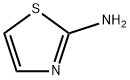
General procedure for the synthesis of 2-bromothiazole from 2-aminothiazole: 2-aminothiazole (0.25 mol) and 150 mL of 45% sulfuric acid were added to a 500 mL reaction flask, and stirred until the 2-aminothiazole was completely dissolved. The reaction mixture was cooled to 2 °C and 50 mL of 65% concentrated nitric acid was added slowly and dropwise, controlling the reaction temperature to not exceed 10 °C. Subsequently, 50 mL of 5 mol/L sodium nitrite solution was added slowly dropwise, and after the dropwise addition was completed, stirring was continued for 1 hour to keep the reaction temperature below 7 °C. The reaction mixture was dripped into a 200 mL solution containing 74 g of sodium bromide and 40 g of copper sulfate through a dropping funnel for the bromination reaction, controlling the temperature at 6 °C, and the dropping time was about 1.5 hours. After the reaction was completed, N2 gas was removed. After cooling, the pH of the reaction mixture was adjusted to 6-7 with 20% NaOH solution, followed by hydrodistillation to collect the aqueous solution containing 2-bromothiazole. After drying with magnesium sulfate, vacuum distillation was carried out to collect the fraction with a boiling point of 71~73 °C/2.4 kPa to give 35.2 g of 2-bromothiazole in 85.8% yield. In this reaction, keeping the reaction temperature in the range of 0~10 °C not only accelerated the reaction rate, but also reduced the occurrence of side reactions, thus significantly increasing the reaction yield.
References
[1] Synthesis, 2012, vol. 44, # 7, p. 1026 - 1029
[2] Patent: CN105348216, 2016, A. Location in patent: Paragraph 0048; 0049
[3] Recueil des Travaux Chimiques des Pays-Bas, 1934, vol. 53, p. 77,78
[4] Recueil des Travaux Chimiques des Pays-Bas, 1962, vol. 81, p. 554 - 564
[5] Patent: WO2016/55947, 2016, A1. Location in patent: Page/Page column 142