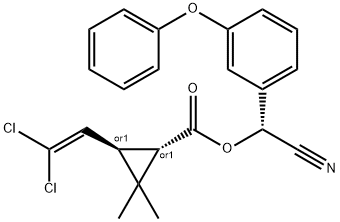
Uses
Theta-cypermethrin is used for public health and animal pest
control.
Definition
ChEBI: (1R)-trans-(alphaS)-cypermethrin is a cyclopropanecarboxylate ester. It is an enantiomer of a (1S)-trans-(alphaR)-cypermethrin.
Production Methods
Theta-cypermethrin is produced through the same broad industrial logic used for other cypermethrin isomer products: manufacturers first construct the chrysanthemate acid component and the appropriate cyanophenoxybenzyl alcohol component, then combine them under controlled ester-forming conditions, and finally refine the resulting mixture to isolate the specific isomeric profile sold as theta-cypermethrin. Upstream work involves assembling the halogenated phenoxybenzyl alcohol, preparing the acid chloride or activated ester of the chrysanthemate moiety, and managing stereochemistry so that the final product meets the required cis/trans and R/S ratios. These two components are then brought together in an esterification step designed to minimise side reactions and unwanted isomers. The crude product is purified through solvent washes, phase separations, and crystallisation or distillation to reach technical-grade theta-cypermethrin.
Mechanism of action
Non-systemic with contact and stomach action. Sodium channel modulator.
Metabolic pathway
Theta-cypermethrin is composed of two of the four trans-cypermethrin
isomers of cypermethrin (1RtransaS and 1StransaR). The fate of these two
isomers (separately) has been reported for soils. Metabolite analysis was
conducted in enough detail to indicate that the fate of the components
was very similar to their fate when presented to biological systems as part
of cypermethrin. Thus reference can be made to the cypermethrin entry
for details. The structure and Scheme numbering used below refers to the
cypermethrin entry.
Degradation
Theta-cypermethrin is stable as a solid but it is readily hydrolysed in
alkaline solution. Its half-lives at pH values 3,7 and 9 (25 °C) were 50,20
and 10 days (PM). By analogy with cypermethrin, the rate-determining
step in dilute solution is nucleophilic attack by OH-. Half-lives of transcypermethrin
in river water and sea water at 25 °C were 5 and 7 days,
respectively. Major products were 3-(2,2-dichlorovinyl)-2,2-dimethylcyclopropanecarboxylic
acid (2, DCVA), 3-phenoxybenzaldehyde (9,
3PBAl) and a-carbamoyl-3-phenoxybenzyl 3-(2,2-dichlorovinyl)-2,2-
dimethylcyclopropanecarboxylate (the amide 3); minor products were the
a-carboxy analogue of 3 (4) and 3-phenoxybenzoic acid (10,3PBA) (see
cypermethrin, Schemes la and 1b).
Photodecomposition would be expected to be similar to that of
cypermethrin.
Pesticide Type
Insecticide