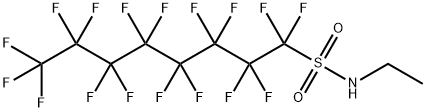
Description
Sulfluramid is an insecticide. It has a low aqueous solubility, is quite volatile and is non-mobile. There are gaps in environmental fate knowledge but is known to be resistant to microbial degradation and photolysis. It has a low mammalian toxicity but there is some concern regarding its potential for bioaccumulation. It is not highly toxic to birds but is more of a concern for aquatic species and honeybees.
Chemical Properties
Tan Powder
Uses
Sulfluramid is an insecticide.
Uses
Sulfluramid is used for the control of ants and roaches in households
and of the red imported fire ant in wider situations.
Definition
ChEBI: A sulfonamide obtained by the formal condensation of perfluorooctane-1-sulfonic acid with ethylamine.
Production Methods
Sulfluramid is commercially produced via nucleophilic amidation of perfluorooctanesulfonyl fluoride with ethylamine in an inert solvent like dichloromethane under mild basic conditions (e.g., triethylamine catalysis) yielding the crude active substance.
Agricultural Uses
Insecticide, Acaricide, Termiticide: Used as ant, roach and termite trap bait. Not listed
for use in EU countries. Actively registered for use in
the U.S. According to the Fluoride Action Network, this
chemical is not registered for use on food or crops and is
scheduled to phased out by 2016.
Trade name
FINITRON®; FIRSTLINE®;
FLUORGUARD®; GX-071®; MICRO-GEN ANT
REACTOR®; VOLCANO®
Mechanism of action
Toxin with stomach action, acts by inhibiting insect energy production. Uncoupler of Oxidative Phosphorylation via disruption of proton gradient
Metabolic pathway
Sulfluramid is a highly fluorinated sulfonamide which was introduced
relatively recently for the control of ants and roaches. It is also used now
for the control of the red imported fire ant (Solenupsis invicta). Its fate
in rats has been studied but, due to its limited use pattern, there appears
to be no information yet published on its environmental fate nor on
its metabolism in plants. It is biotransformed by N-de-ethylation to an
insecticidally active and toxic metabolite.
Degradation
Sulfluramid is stable for more than 90 days at 50 °C and it is similarly
stable in light under glass. Though a weak acid, it is highly lipophilic due
to the perfluorooctyl group.
Pesticide Type
Insecticide; Acaricide