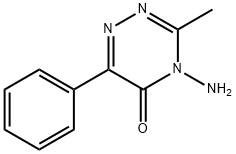
Description
Metamitron is a widely used herbicide. It is highly soluble in water and is not considered to be highly volatile. It can be moderately persistent in some soil systems depending on local conditions. Metamitron may also be persistent in aquatic systems. Generally, it is quite toxic to most fauna and flora. Metamitron is moderately toxic to mammals if ingested, is an endocrine disruptor and may be a thyroid toxicant.
Chemical Properties
Phenazinone pure product is colorless and odorless crystal, melting point 166.6°C. Vapor pressure 8.6×10⁻⁴mPa(20°C), 2×10⁻³mPa(25°C). Vapor pressure 8.6×10⁻⁴mPa(20℃),2×10-3mPa(25℃).KowIgP=0.83,Henry's constant 1×10⁻⁷Pa-m /mol(20℃),density 1.35g/cm3(22.5℃C). Solubility(20℃,g/L):water1.7,isopropanol5.7,methanol23,ethanol1.1,dichloromethane30~50,hexane<0.1,cyclohexanone10~50,toluene2.8,chloroform29.Stability: stable in acid,unstable in strong base(pH>10).DT50(22℃): 410d(pH 4),740h(pH 7) , 230h (pH 9). Photolysis was very rapid at the soil surface and more rapid in water.
Definition
ChEBI: A member of the class of 1,2,4-triazines that is 1,2,4-triazin-5(4H)-one substituted by an amino group at position 4, a methyl group at position 3 and a phenyl group at position 6.
Production Methods
Metamitron is commercially produced through a chemical synthesis that builds on the triazinone structure, derived from cyanuric chloride or similar triazine precursors. The process involves substitution reactions where methyl, amino, and phenyl groups are introduced at specific positions on the triazine ring to form the active herbicidal compound.
General Description
4-Amino-3-methyl-6-phenyl-1,2,4-triazin-5-one, commonly known as metamitron, is a pesticide having low polarity and is hydrophobic in nature. Its pKa value is 2.9.
Agricultural Uses
Herbicide: Metamitron is a selective systemic herbicide that is
absorbed through roots and leaves and inhibits photosynthesis. It is used to control grasses and broadleaf weeds
in sugar beets and fodder beets. Not currently registered
in the U.S. Used in most European countries and having
34 global suppliers
.
Trade name
BAY 6676®; BAY-DRW 1139®; DRW
1139®; GALAHAD®; GOLDBEET®; GOLTIX®;
GOLTIX® 90; GOLTIX® SUPER; GOLTIX® WG;
MM 70®; HERBRAK®; MARQUISE®; SKATER®;
TORERO® (metamitron + ethofumesate)
Mechanism of action
Selective, systemic, absorbed mainly by roots and translocated. Inhibits photosynthesis (photosystem II).
Metabolic pathway
Degradation of metamitron by photolysis is strongly
dependent on solvents and oxygen, and no
photoreaction is found in methanol, acetonitrile, and
hexane, nor in oxygen-free water. In water solution,
photolytic degradation occurs and results in the
formation of desaminometamitron and a ring-opening
polar benzoylacetyl hydrazine (tentatively assigned).