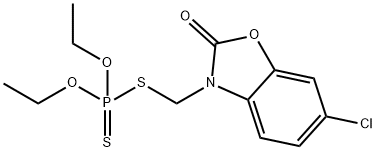
Chemical Properties
The pure product is white crystals with a garlicky odor. Its mp is 48°C, and its volatility is low. The saturated concentration in air is less than 0.01 mg/m?? at 24°C, approximately 0.02 mg/m?? at 40°C, approximately 0.1 mg/m?? at 50°C, and approximately 0.3 mg/m?? at 60°C. It is readily soluble in organic solvents such as acetone, acetonitrile, acetophenone, benzene, chloroform, cyclohexanone, dioxane, ethyl acetate, dichloroethane, methyl ethyl ketone, toluene, and xylene. It is soluble in methanol and ethanol at a solubility of approximately 20%. It is insoluble in water at a solubility of approximately 0.1%. It is stable and exhibits no noticeable degradation after two years of storage at room temperature or 30 days at 50°C. It is non-corrosive.
Uses
Insecticide, acaricide.
Uses
Insecticide; acaracide
Uses
Phosalone is a organophosphate compouund used as insecticide and acaricide. Phosalone is a weak inhibitor of acetylcholinesterase.
Uses
Phosalone is used to control codling moth, aphids, beetles and
thrips on fruit trees
Definition
ChEBI: A member of the class of 1,3-benzoxazoles carrying a [(diethoxyphosphorothioyl)sulfanyl]methyl group at the nitrogen atom, an oxo group at position 2 and a chloro group at position 6. It is an organothiophosphate insecticide.
Production Methods
Phosalone is synthesised through a condensation reaction involving sodium or ammonium diethyldithiophosphates and 6-chloro-3-chloromethylbenzoxazolone.
Mechanism of action
Non-systemic with contact and stomach action. Acetylcholinesterase (AChE) inhibitor.
Safety Profile
Poison by ingestion, skin contact,and possibly other routes. A cholinesterase inhibitor. Seealso PARATHION. When heated to decomposition itemits very toxic fumes of Cl-, NOx, POx, and SOx.
Environmental Fate
Plant. Degrades in plants to chlorbenzoxazolone, formaldehyde and diethyl phosphorodithioate (Hartley and Kidd, 1987)
Soil. Ambrosi et al. (1977a) studied the persistence and metabolism of phosalone in
both moist and flooded Matapeake loam and Monmouth fine sandy loam. Phosalone rapidly
degraded (half-life 3 to 7 days) but mineralization to carbon dioxide accoun
Chemical/Physical. Emits toxic fumes of chlorine, phosphorus, nitrogen and sulfur
oxides when heated to decomposition (Sax and Lewis, 1987)
Metabolic pathway
Photodegradation of phosalone in solvent yields
dechlorinated phosalone. Irradiation in methanol
affords O,O-diethyl-S-methylphosphorothioate and 6-
chloro-3-methoxymethyl-2-oxobenzoxazoline with other
common products. Photolysis of phosalone in the solid
state as a thin film on a glass surface produces a
number of photoproducts including 6-chloro-3-
mercaptomethyl-2-oxobenzoxazoline and its dimeric
disulfide.
Metabolism
Orally administered phosalone in mammals is rapidly
degraded by oxidation and hydrolysis to give O,O-diethyl
hydrogen phosphorothioate and phosphorodithioate and
6-chloro-2,3-dihydro-2-oxobenzoxazole, which is further
metabolized and excreted in the urine. It is strongly
adsorbed to soil and rapidly degraded with DT50 values
of 1–4 d.
Degradation
Phosalone is hydrolysed by strong acids and alkalis with a DT50, of
9 days at pH 9 (PM).
Pesticide Type
Insecticide; Acaricide