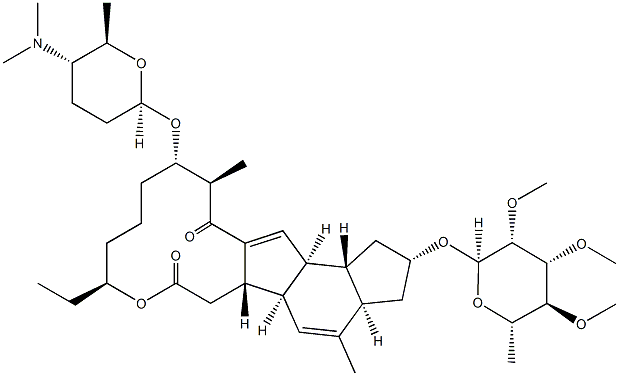
Chemical Properties
pale off-white crystalline solid with a slight stale earthy odor. Its vapor pressure is approximately 1.3×10⁻¹⁰ Pa. In aqueous solution at a pH of 7.74, it is relatively stable to metals and metal ions for 28 days. Its photodegradation half-life in soil is 9-10 days; its half-life in water is <1 day. It is relatively stable in aqueous solution within the pH range of 5-7; at pH 9, its half-life is >200 days. Spinosad is a mixture of more than ten components, the main ones being A and D. Spinosad A has a melting point of 84-99.5°C and a vapor pressure of 3.2×10⁻¹⁰ Pa. Its solubility in water is 290 mg/L (pH 5.0), 235 mg/L (pH 7.0), and 16 mg/L (pH 9.0). Its partition coefficients are 2.8, 4.0, and 5.2 at the corresponding pH values, respectively. Spinosad D has a melting point of 161.5-170°C, a vapor pressure of 2.1×10⁻¹⁰ Pa, and solubilities in water of 29 mg/L (pH=5.0), 0.332 mg/L (pH=7.0), and 0.053 mg/L (pH=90.0). The partition coefficients are 3.2, 4.5, and 5.2 at the corresponding pH values, respectively.
Uses
Spinosyn D is the second most abundant component (comprising up to 15%) of the spinosyn fermentation complex of macrocyclic lactones. Spinosyn D is a more hydrophobic analogue, and is a potent insecticide for crop pathogens and ectoparasite control on animals, albeit less active than spinosyn A. The spinosyns have a unique mechanism of action involving disruption of nicotinic acetylcholine receptors.