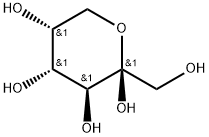
Fructose can be used in animal modeling to create rat models of hyperuricemia and diabetes. In mice fed a 0% Fructose diet, portal vein (0.060±0.006 mM, overall average across all time points) and systemic (0.030±0.003 mM) Fructose concentrations do not change over time after feeding. In contrast, in wild-type mice, the portal vein concentration more than doubles from time (t)=0 to t=1 hour post-feeding (~0.13 mM). Similarly, systemic serum Fructose increases from 0.037 at t=0 to 0.13 mM one hour post-feeding. In the 20% group, fasting (t=0) serum Fructose levels in the portal vein and systemically are similar to the postprandial concentrations in 0% mice, suggesting that baseline Fructose concentrations during fasting are not affected by diet. At the same dietary conditions, time, and sampling site, serum Fructose concentrations in KHK-/- mice are 5 to 100 times higher than in wild-type mice. The mean (across all time points) portal vein and systemic glucose concentrations in mice fed 20% Fructose are approximately 3 (P=0.004) and 2 (P=0.04) mM higher, respectively, compared to mice fed 0% Fructose. Systemic Fructose concentrations in KHK-/- mice fed 20% Fructose are about three times higher than in mice fed glucose, whereas systemic Fructose concentrations in wild-type mice fed Fructose are similar to those fed glucose[2].
Induces high uric acid[3]
Background
Fructose accelerates the synthesis of purines, increases the production of uric acid, reduces the excretion of uric acid by affecting kidney function, and also produces a large amount of reactive oxygen species, leading to oxidative stress, activating inflammatory signaling pathways and promoting uric acid production.
Specific Modeling Methods
Mice: ICR male mice 18-22 g
Administration: 30% Fructose in drinking water intragastrically for six weeks
Note
(1) Mice were placed in a temperature and humidity controlled environment with a 12 h light-dark cycle[3].
(2) Fresh drinking water was replaced every 2 days[3].
(3) 24 h urine volume was collected and recorded[3].
Modeling Indicators
Molecular changes: mouse renal urate transporter 1 (URAT1), glucose transporter 9 (GLUT9) increased protein levels, ATP-binding cassette subfamily G member 2 (ABCG2) and organic anion transporter 1 (OAT1) decreased protein levels, and organic cation transporter 1 (OCT1) and OCT2 were downregulated. Increases protein levels of TLR4 and MyD88 in the kidneys. NLRP3 inflammasome is activated and IL-1β secretion is increased[3].
Tissue changes: Infiltration of inflammatory cells in mouse glomeruli[3].
Metabolic changes: Increase serum uric acid, creatinine, blood urea nitrogen levels, reduce urine uric acid and creatinine levels (FEUA is significantly reduced)[3].
Correlated Product(s): /
Opposite Product(s): /
Induces type 2 diabetes[4]
Background
Fructose's metabolites induce insulin resistance, and the reactive oxygen species produced lead to oxidative stress, activate inflammatory responses and affect the action of insulin. Fructose is rapidly metabolized in the liver, resulting in excess production, leading to obesity and hyperlipidemia.
Specific Modeling Methods
Rat: Male Sprague Dawley rats 200-250 g
Administration: 65% fructose oral administration 8 weeks of feeding
Note
(1) At 3 and 8 weeks, blood was collected from the retroorbital plexus using small capillary tubes and serum was collected for biochemical analysis[4].
Modeling Indicators
Molecular changes: Serum glucose, insulin, triglyceride, uric acid levels and insulin resistance were significantly increased. TBARS in liver tissue increased and GSH levels decreased[4].
Correlated Product(s): /
Opposite Product(s): /