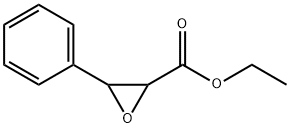
General Description
Clear pale yellow or yellow liquid.
Reactivity Profile
Epoxides are highly reactive. They polymerize in the presence of catalysts or when heated. These polymerization reactions can be violent. Compounds in this group react with acids, bases, and oxidizing and reducing agents. They react, possibly violently with water in the presence of acid and other catalysts.
Air & Water Reactions
Slightly water soluble.
Fire Hazard
This chemical is probably combustible.
Chemical Properties
Ethyl 3-phenylglycidate has a strong, fruity odor suggestive of strawberry with a corresponding sweet flavor.
Chemical Properties
Ethyl 3-Phenylglycidate is a colorless liquid
with a strawberry-like odor.
It is prepared by treating ethyl cinnamatewith peracetic acid or by condensation
of benzaldehyde with ethyl chloroacetate (in the aforementioned Darzens
reaction, R == H).Theglycidate is used as a long-lasting fragrancematerial for creating
harmonic, fruity notes in household and fine fragrances.
Chemical Properties
pale yellow liquid
Occurrence
Apparently has not been reported to occur in nature.
Uses
Ethyl 3-Phenyloxirane-2-carboxylate is used in preparation method of early-strength viscosity-breaking Polycarboxylate water reducer containing three viscosity-breaking group and used as concrete additive.
Definition
ChEBI: Ethyl phenylglycidate is an epoxide and a carboxylic acid.
Preparation
Usually prepared by the reaction of benzaldehyde and the ethyl ester of monochloracetic acid in the presence of an alka�line condensing agent; by reacting the silver salt of phenyl glycidic acid with ethyl iodide.
Aroma threshold values
Detection: 8.5 ppm
Taste threshold values
Taste characteristics at 30 ppm: sweet, fruity and berry with dried fruit and floral nuance.
Flammability and Explosibility
Nonflammable