Pyrroloquinoline quinone:Functions, benefits and Effects of PQQ on health
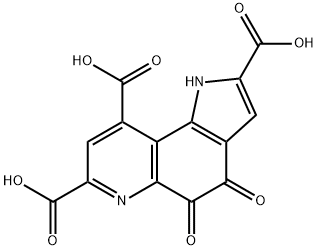
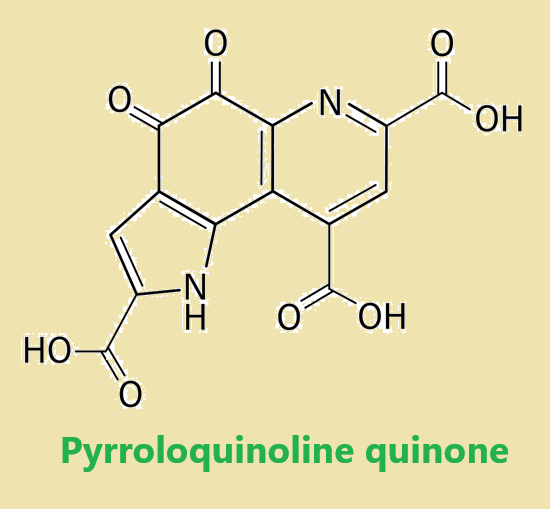
Pyrroloquinoline quinone (PQQ) is a compound found ubiquitously in plants, many simple and single cell eukaryotes (e.g., yeast), and certain bacteria. Early studies in mice and rats revealed that diets deficient in PQQ resulted in growth impairment, compromised immune response, abnormal reproductive performance, and metabolic inflexibility.[1]

Functions and benefits
Pyrroloquinoline quinone (PQQ) is an aromatic water-soluble quinone whose chemical properties are analogous to combining the chemical features of ascorbic acid, riboflavin and pyridoxal-5-phosphate into one molecule. For example, both the oxidized (PQQox) and reduced (PQQH2) forms of PQQ carry out redox cycling. PQQ also serves as a dehydrogenase cofactor, a free radical scavenger, and an amine oxidase catalyst. PQQ is highly electrophilic and reacts with many substances (e.g., various carbonyl reagents, such as hydrazine, hydroxylamine and semicarbazides). Moreover, PQQ forms complexes with acetone, aminoguanidine, urea, various diamines, and divalent metals. In addition, PQQ reacts with ammonia to produce an iminoquinone, and under acidic conditions, internal lactones are formed, in contrast to the formation of dihydrates under neutral and basic conditions.[2]
As a redox cofactor, Pyrroloquinoline quinone is capable of catalyzing continuous redox reactions involving oxidation of thiols, riboflavin, ubiquinone, terminal cytochromes, α–tocopheroxyl radicals and nicotinamide adenine dinucleotide cofactors. As an antioxidant, PQQH2 can act as an aroxyl radical scavenger, even more so than α-tocopherol, against peroxyl radicals. Moreover, in combination with α-tocopherol, PQQH2 can protect α-tocopherol by reducing α-tocopheroxyl radicals generated in the oxidation of polyunsaturated lipids.
Effects of PQQ supplementation on health
Supplementation of PQQ is found to aid in weight loss, improve insulin sensitivity, and help prevent metabolic syndrome. Metabolic disorders like type 2 diabetes (T2D) and metabolic syndromes are primarily characterized by insulin resistance. PQQ has shown promising results in increasing insulin sensitivity, potentially aiding in the prevention or management of metabolic disorders. Obesity around the middle ages, abnormal lipid profiles, high blood pressure, and poor glucose tolerance are all components of metabolic syndromes, which increases the risk of cardiovascular disease and T2D.
In addition to its effects on energy metabolism, PQQ has been associated with various other potential benefits for overall health and well-being.
References
[1] K. JONSCHER R. R. Pyrroloquinoline Quinone[J]. Dietary Interventions in Liver Disease, 2019, 99 3. DOI:10.1016/B978-0-12-814466-4.00013-6.
[2]Jonscher KR, Chowanadisai W, Rucker RB. Pyrroloquinoline-Quinone Is More Than an Antioxidant: A Vitamin-like Accessory Factor Important in Health and Disease Prevention. Biomolecules. 2021 Sep 30;11(10):1441. doi: 10.3390/biom11101441. PMID: 34680074; PMCID: PMC8533503.
You may like
Related articles And Qustion
See also

Lastest Price from Pyrroloquinoline quinone manufacturers

US $0.00-0.00/kg2025-08-19
- CAS:
- 72909-34-3
- Min. Order:
- 1kg
- Purity:
- ≥98%(HPLC)
- Supply Ability:
- 2tons

US $0.00-0.00/g2025-05-21
- CAS:
- 72909-34-3
- Min. Order:
- 100g
- Purity:
- 99%
- Supply Ability:
- 50kg