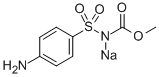
Asulam sodium is a carbamate herbicide. It is highly soluble in water, volatile with a low risk of leaching to groundwater. It is not persistent in soils but may be persistent in water especially under dark conditions. Although it is not highly toxic there is a risk of bioaccumulation. It is a skin, eye and respiratory system irritant and may cause undesirable effects on reproduction. Asulam sodium is moderately toxic to birds, most aquatic organisms, honeybees and earthworms.
Asulam sodium is synthesised through a multi-step chemical. The production begins by mixing sodium methoxide solution with methanol and stirring to form a homogeneous mixture. Sulfanilamide is then added, and the solution is heated to initiate the primary reaction. Next, dimethyl carbonate is introduced. Another reagent is added to inhibit byproduct formation, and the mixture is stirred again for several hours. Finally, the solution is distilled under normal pressure to recover methanol, the pH is adjusted between 2 and 8, and the asulam sodium is isolated as a solid through separation and drying.
ChEBI: Asulam-sodium is an organic sodium salt obtained by formal reaction of equimolar amounts of azulam and sodium. A dihydropteroate synthase inhibitor, it is used as a herbicide (mainly for killing bracken). It has a role as a herbicide, an agrochemical and an EC 2.5.1.15 (dihydropteroate synthase) inhibitor. It contains an asulam(1-).
Selective system action, absorbed by leaves, shoots and roots. Inhibition of dihydropterate synthase causing slow chlorosis.