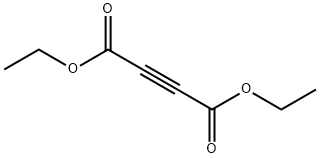
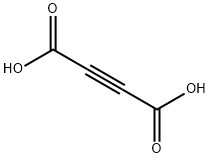
Diethyl acetylenedicarboxylate is a clear light yellow liquid which has a disagreeable smell. It is a cheap and readily available material in industry. The triple bond is a critical and useful functional group, and it has extensive applications in organic synthesis. It can react with amines, aldehydes, ketones, etc. Therefore it can be used to form various heterocycles.
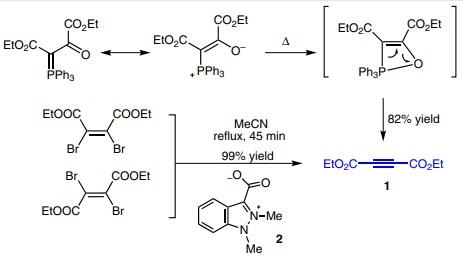
Synthesis of diethyl acetylenedicarboxylate
Diethyl acetylenedicarboxylate was used in the synthesis of:
- 3,4,5-trisubstituted 2(5H)-furanone derivatives
- highly functionalized thiazolidinone derivatives
- novel cyclic peroxide glucosides
- 4,11-dimesitylbisanthene, soluble bisanthene derivative, via Diels-Alder reaction
Diethyl acetylenedicarboxylate is used as a protein cross-linker. It is also used in the synthesis of 3,4,5-trisubstituted 2(5H)-furanone derivatives, highly functionalized thiazolidinone derivatives, novel cyclic peroxide glucosides and 4,11-dimesitylbisanthene, soluble bisanthene derivative, via Diels-Alder reaction.
Diethyl acetylenedicarboxylate is a protein cross-linker.
1. In a 250 mL round-bottomed flask, ethanol (1.2 g, 26 mmol), butynedioic acid (1 g, 8.77 mmol), p-toluenesulfonic acid (30 mg, 0.17 mmol), and 1,2-dichloroethane (50 mL) were added sequentially, and refluxed with heat for 12 h. 2. After the reaction was completed, toluene (50 mL, with moisture trap) was added to the reaction system, and refluxed for 8 h. 3. reflux for 8 h. 3. The reaction solution was concentrated and purified by fast column chromatography (eluent: petroleum ether/ethyl acetate = 98/2) to give purified diethyl butynedioate (1.35 g, 91% yield).
Dissolve the ester in *C6H6, wash it with NaHCO3, H2O, dry over Na2SO4, filter, evaporate and distil it in a vacuum [IR: Walton & Hughes J Am Chem Soc 79 3985 1957, Truce & Kruse J Am Chem Soc 81 5372 1959]. [Beilstein 2 H 803.]
[1] Patent: CN103483194, 2016, B. Location in patent: Paragraph 0045
[2] European Journal of Organic Chemistry, 2015, vol. 2015, # 20, p. 4519 - 4523
[3] Journal fuer Praktische Chemie (Leipzig), 1892, vol. <2>46, p. 209
[4] Journal fuer Praktische Chemie (Leipzig), 1895, vol. <2>52, p. 289,326,359,
[5] Chemische Berichte, 1885, vol. 18, p. 2271