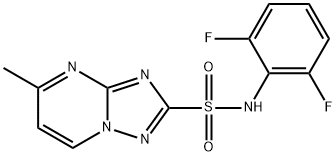
Flumetsulam is a selective, post-emergence herbicide used mainly to control broadleaved weeds and some grasses. It is highly soluble in water and has a low volatility. It can be moderately persistent in some soil systems and very persistent, depending on conditions, in water bodies. There is a significant potential for it to leach to groundwaters. Its mammalian oral toxicity is low and it can be an irritant for skin and eyes. Other data related to chronic health is missing. Generally, it has a low toxicity for most biodiversity.
Flumetsulam is a colorless liquid which
does not exist as a free, pure substance. Used as an
aqueous solution.
Flumetsulam is a ighly active herbicide of the triazolopyrimidine sulfonanilide class. Flumetsulam act by inhibiting acetolactate synthase. Flumetsulam exhibits broad spectrum activity on broadleaf weed species with selectivity to several major agronomic crops in soil and foliar applications.
ChEBI: Flumetsulam is a sulfonamide.
Flumetsulam is commercially produced through a multi-step synthesis that constructs its complex heterocyclic structure. The process typically begins with the formation of a substituted pyrimidine ring, which is then functionalised with a sulfonamide group and a difluorophenyl moiety. Key intermediates include 5-methyltriazolo[1,5-a]pyrimidine and 2,6-difluoroaniline, which are coupled under controlled conditions using chlorosulfonic acid or similar reagents to form the sulfonamide linkage. The reactions are carried out in organic solvents under regulated temperature and pH to ensure high yield and purity.
Selective, systemic, absorbed by roots and leaves. Inhibits plant amino acid synthesis - acetohydroxyacid synthase AHAS.
UN3082 Environmentally hazardous substances,
liquid, n.o.s., Hazard class: 9; Labels: 9-Miscellaneous haz ardous material, Technical Name Required.
The initial threshold screening level (ITSL) for flumetsulam is 26 μg/m3 based on an annual averaging time.
Must be disposed properly by
following package label directions or by contacting your
local or federal environmental control agency, or by con tacting your regional EPA office. If this material cannot be
disposed of according to label instructions, it may be dis solved or mixed with a combustible solvent and burned in
a chemical incinerator equipped with an afterburner and
scrubber. In accordance with 40CFR165, follow recommen dations for the disposal of pesticides and pesticide contain ers. Noncombustible containers should be crushed and
buried under more than 40 cm of soil.