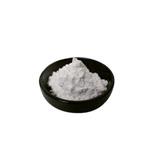
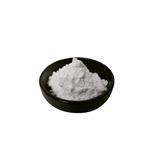
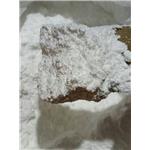
White to off-white or light tan powder
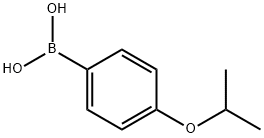
4-Isopropoxyphenylboronic Acid is used to synthesize potent cytotoxic analogues of the marine alkaloid Lamellarin D. It is also used to synthesize cyclooxygenase-2 (COX-2) inhibitors.
Reactant for:• ;Microwave-mediated click-chemistry synthesis of glyco-porphyrin derivatives with in vitro photo-cytotoxicity for application in photodynamic therapy1• ;Palladium-catalyzed oxidative cross-coupling reactions2• ;Ruthenium-catalyzed hydrogenation reactions3• ;Stereoselective rhodium-catalyzed arylation4• ;Palladium acetate catalyzed C-glycosidation5
Contains varying amounts of anhydride
A pentane solution of tert-butyllithium (1.28 M, 51.5 mL, 66.0 mmol) was added dropwise to a solution of 4-isopropoxybromobenzene (5.61 g) in THF (150 ) at -78 C under an argon atmosphere.
mL) to a solution of 4-isopropoxybromobenzene (5.61 g) in THF (150 ). The mixture was stirred for 1 hour. Trimethyl borate (5.02 mL, 45.0 mmol) was
was added to the mixture as a pure liquid. Stir the mixture at -78 C for 1 hour. Allow the reaction mixture to warm to room temperature. Stir the reaction mixture for another 1 hour. Quench the mixture with saturated NH4Cl
Quench the mixture with saturated NH4Cl aqueous solution. Evaporate the mixture under reduced pressure. Adjust the pH of the residue to 3 by adding 3 M aqueous HCl. Extract the mixture with dichloromethane. Wash the extract with brine. Dry the extract with Na2SO4.
Na2SO4 to dry the extract. Evaporate the extract under reduced pressure. The residual solid was washed with hexane. Filter the solid to obtain 4-isopropoxyphenylboronic acid.