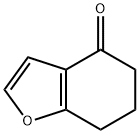
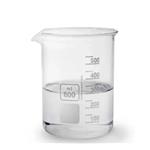
6,7-Dihydro-4(5H)-benzofuranone is a benzofuran derivative that consists of fused benzene and furan ring. Its standard molar enthalpy of formation by static bomb calorimetry and standard molar enthalpy of vaporization using Calvet microcalorimetry has been measured. These values have been used to derive the standard molar enthalpy of formation in gaseous phase.
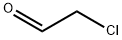
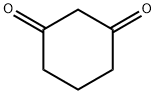
Under argon protection, 1,3-cyclohexanedione (20.71 g, 0.18 mol) was dissolved in methanol (100 mL) and the solution was cooled to 0 °C. Subsequently, potassium hydroxide (12.2 g, 0.18 mol) was added to the solution and stirred continuously for 30 minutes at 0 °C. Next, 50% aqueous chloroacetaldehyde solution (26.3 mL, 0.203 mol) was slowly added. The reaction mixture was stirred overnight at room temperature. Upon completion of the reaction, the solution was acidified to pH < 7 with 1N hydrochloric acid and then extracted with ethyl acetate. The organic layers were combined, washed sequentially with water and saturated saline, and dried over anhydrous magnesium sulfate. Finally, the solvent was removed by concentration under reduced pressure to give the crude 6,7-dihydro-4(5H)-benzofuranone product (16.5 g), which was pure enough to be used directly in the next step of the reaction.
[1] Arkivoc, 2011, vol. 2011, # 9, p. 1 - 14
[2] Heterocycles, 2004, vol. 62, p. 807 - 813
[3] Bioorganic and Medicinal Chemistry, 2008, vol. 16, # 4, p. 1966 - 1982
[4] Journal of Organic Chemistry, 1988, vol. 53, # 17, p. 4135 - 4137
[5] Chemical and Pharmaceutical Bulletin, 1994, vol. 42, # 10, p. 2167 - 2169