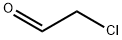
oroacetaldehyde is a combustible, colorless liquid with a very sharp, irritating odor. Molecularweight=78.50; Specific gravity (H2O:1)=1.19 (40%solution); Boiling point=85 100℃; Freezing/Meltingpoint=16℃(40% solution); Vapor pressure 5100 mmHg at 20℃; Flash point=87.7℃(40%626 Chloroacetaldehydesolutions). Hazard Identification (based on NFPA 704 MRating System): Health 3, Flammability 2, Reactivity 0(able to polymerize on standing). Soluble in water.
Chloroacetaldehyde is a combustible, colorless liquid with a very sharp, irritating odor.
Clear, colorless liquid with an irritating, acrid odor
In the manufacture of 2-
aminothiazole; to facilitate bark removal from
tree trunks; formed during the chlorination of
drinking water; a metabolite of vinyl chloride
Chloroacetaldehyde is used in the productionof 2-aminothiazole.
ChEBI: Chloroacetaldehyde is acetaldehyde substituted at C-2 by chlorine. It derives from an acetaldehyde.
A clear colorless liquid with a pungent odor. Flash point about 190°F. Corrosive to skin and mucous membranes. Chloroacetaldehyde is very toxic by inhalation.
Soluble in water. Forms an insoluble hemihydrate at greater than 50% concentration.
Chloroacetaldehyde polymerizes on standing. At greater than 50% concentration in water, Chloroacetaldehyde forms an insoluble hemihydrate. Sensitive to heat. Reacts with oxidizing agents. Incompatible with acids and water . Burns to give poisonous and irritating gases.
Corrosive to skin and mucous membranes.
TLV: ceiling 1 ppm.
Chloroacetaldehyde is a highly toxic andcorrosive compound that can injure the eyes,skin, and respiratory system. Exposure toits vapor at high concentrations can producesevere irritation and impair vision. At lowconcentrations, the vapor can cause irritationand sore eyelids. Brief contact with 40%aqueous solution can result in skin burn anddestruction of tissues. A 0.5% dilute solutioncan still be irritating on skin.
Inhalation of its vapor at the 5-ppm levelcan irritate the eyes, nose, and throat. Ingestionmay result in pulmonary edema. Swallowinga concentrated solution may be fatal.The acute toxicity data are as follows:
LD50 value, intraperitoneal (rats): 2 mg/kg
LD50 value, oral (rats): 23 mg/kg
LD50 value, skin (rabbits): 67 mg/kg
This compound is a mutagen, testing positivein the Ames test.
Combustible; flash point (closed cup) 87.8°C
(190°F); flash point of 50% aqueous solution
53°C (128°F) (at this concentration it may
form insoluble hemihydrate); it forms an
explosive mixture with air. Reactions with
strong acids and oxidizers are exothermic.
Suspected carcinogen.
Poison by ingestion, skin contact, and
intraperitoneal routes. Mutation data
reported. Combustible when exposed to
heat or flame. Reacts with oxidizing
materials. To fight fire, use water, foam,
CO2, dry chemical. When heated to
decomposition it emits toxic fumes of Cl-.
See also ALDEHYDES and CHLORIDES.
Chloroacetaldehyde is used as a fungicide; as an intermediate in 2-aminothiazole manufacture;
and in bark removal from tree trunks.
If this chemical gets into the eyes, remove anycontact lenses at once and irrigate immediately for at least30 min, occasionally lifting upper and lower lids. Seek medical attention immediately. If this chemical contacts theskin, remove contaminated clothing and wash immediatelywith soap and water. Seek medical attention immediately. Ifthis chemical has been inhaled, remove from exposure,begin rescue breathing (using universal precautions, including resuscitation mask) if breathing has stopped and CPR ifheart action has stopped. Transfer promptly to a medicalfacility. When this chemical has been swallowed, get medical attention. Give large quantities of water and inducevomiting. Do not make an unconscious person vomit.Medical observation is recommended for 24-48 h afterbreathing overexposure, as pulmonary edema may bedelayed. As first aid for pulmonary edema, a doctor orauthorized paramedic may consider administering a corticosteroid spray.
Chloroacetaldehyde has been reported to
be an inhibitor of DNA synthesis and to form
DNA adducts; it is mutagenic in Salmonella
typhimurium and in Chinese hamster cells.
Limited in vivo genotoxicity studies with
chloroacetaldehyde were negative.
Chemical/Physical. Polymerizes on standing (Windholz et al., 1983).
Polymerizable upon standing. Color Code—Blue:Health Hazard/Poison: Store in a secure poison location.Prior to working with chloroacetaldehyde you should betrained on its proper handling and storage. Store in tightlyclosed containers in a cool, dry, well-ventilated area. Metalcontainers involving the transfer of this chemical should begrounded and bonded. Where possible, automatically pumpliquid from drums or other storage containers to processcontainers. Drums must be equipped with self-closingvalves, pressure vacuum bungs, and flame arresters. Useonly nonsparking tools and equipment, especially whenopening and closing containers of this chemical. Sources ofignition, such as smoking and open flames, are prohibitedwhere this chemical is used, handled, or stored in a mannerthat could create a potential fire or explosion hazard.
UN22322-Chloroethanal, Hazard class: 6.1;
Labels: 6.1-Poison Inhalation Hazard, Inhalation Hazard
Zone B.
Heat and water sensitive; concentrations
of .50% form insoluble hemihydrate material on contact
with water. Reacts with oxidizers, acids. On heating,chloroacetaldehyde releases chlorine fumes. Polymerizable
upon standing
Incineration, preferably after
mixing with another combustible fuel; care must be exercised to assure complete combustion to prevent the formation of phosgene; an acid scrubber is necessary to remove
the halo acids produced.