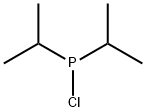
Chlorodiisopropylphosphine is an organophosphorus compound of particular interest in synthetic chemistry, where it is used as a reagent in the preparation of phosphine ligands for transition metal complexes. Its utility in synthesising these complexes is due to the reactivity of the chloro group, which other groups can substitute to create a diverse array of ligands. This reactivity is also exploited in the study of catalysis, as the resulting phosphine ligands can be used to modulate the activity and selectivity of metal catalysts. In addition, Chlorodiisopropylphosphine is investigated for its potential in forming new organophosphorus compounds with applications in materials science. Researchers are also interested in the compound′s role in synthesising flame retardants, where its phosphorus content could contribute to the material′s flame-retarding properties.
Colorless to light yellow liqui
Chlorodiisopropylphosphine can be used:
- To synthesize p-styryldiisopropylphosphine by reacting with 4-chlorostyrene via Grignard reaction.
- As a phosphination reagent in combination with [Cp2Zr(1-butene)(DMAP)] (Cp=cyclopentadienyl; DMAP= 4-(dimethylamino)pyridine)) for the zirconophosphination of alkynes to form zirconoalkenylphosphines.
- A luminescent mixed-donor platinum POCN pincer complex via cyclometalation process.
Chlorodiisopropylphosphine is widely used for preparing organic phosphine pesticides, secondary phosphine, organic phosphine ligand and high-efficiency organic metal catalyst in thermoplastic elastomer synthesis, can also be used as an important component of a non-lethal weapon system, and is recently used for electrochemically synthesizing novel electrolyte salt fluoroalkyl lithium phosphonate of a lithium ion secondary battery as a green energy source due to the special structure of the organic phosphine catalyst.[1]
reagent type: ligand
reaction type: Arylations
Chlorodiisopropylphosphine can be synthesized by using Mg, chloro iso-propane and phosphine trichloride as the main raw material. The optimum reacting condition for the synthesis includes, the material proportioning being PCl3 : i-C3H7C1 = 1 : 1.8 (mol ratio), the reaction temperature being -30 deg. C, dropping time being 1.25h. By employing THF for substituting ether as the solvent, the reaction can be accelerated and the yield can be increased.[1]
[1] The synthetic method of diisopropyl phosphine chloride. Patent CN1724548A.