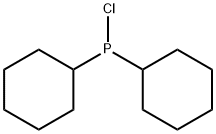
Dicyclohexylchlorophosphine is used as pharmaceutical intermediate. It is also used in the synthesis of various phosphines.
Chlorodicyclohexylphosphine can be used as a reactant in the synthesis of:
- 1,2-Bis(dicyclohexylphosphinoxy)ethane ligand by reacting with ethylene glycol in the presence of triethylamine via MichaelisArbuzov type rearrangements.
- 1,1,2,2-tetracyclohexyldiphosphine monosulfide ligand by treating with LiS.
It can be also used as a starting material for the preparation of some other ligands such as dicyclohexylphosphine oxide , phosphino substituted
N-aryl pyrroles , di-
tert-butyl((dicyclohexylphosphino)methyl)phosphine , dicyclohexylcyclopentylphosphine. These ligands are used in Pd-catalyzed cross-coupling reactions.
Chlorodicyclohexylphosphine can be used as a reactant in the synthesis of:
1,2-Bis(dicyclohexylphosphinoxy)ethane ligand by reacting with ethylene glycol in the presence of triethylamine via MichaelisArbuzov type rearrangements.
1,1,2,2-tetracyclohexyldiphosphine monosulfide ligand by treating with LiS.
It can be also used as a starting material for the preparation of some other ligands such as dicyclohexylphosphine oxide , phosphino substituted N-aryl pyrroles , di-tert-butyl((dicyclohexylphosphino)methyl)phosphine , dicyclohexylcyclopentylphosphine. These ligands are used in Pd-catalyzed cross-coupling reactions.
reaction type: Buchwald-Hartwig Cross Coupling Reaction
reaction type: Heck Reaction
reaction type: Hiyama Coupling
reaction type: Negishi Coupling
reaction type: Sonogashira Coupling
reaction type: Stille Coupling
reaction type: Suzuki-Miyaura Coupling
reagent type: ligand
Dicyclohexylphosphine (98.8%,10.68 g,53.8 mmol) was added to the reaction flask followed by THF (10.85 g). Ethyl trichloroacetate (97%,10.52g,55mmol) was added dropwise to the resulting solution over a period of 30 minutes under stirring (the temperature of the reaction mixture was varied from 18C to 33C by applying external cooling during the addition). The reaction mixture was aged at ambient temperature for two hours (aging means keeping the reaction mixture under specified conditions for a specified time, optionally under stirring). After aging, the reaction mixture was a clear and colorless low viscosity liquid. The crude reaction mixture was subjected to vacuum distillation (96-100 C/3.6 mbar), which resulted in the isolation of dicyclohexylphosphonium chloride in 53% yield and high purity as a clear and colorless low-viscous liquid (31P NMR: 98.78% ;GC-FID: 97.26%).
Store in cool, dry conditions in well sealed containers. Protect from humidity and water. Store under dry inert gas. It is sensitive to air and moisture. Incompatible with strong oxidizing agents.