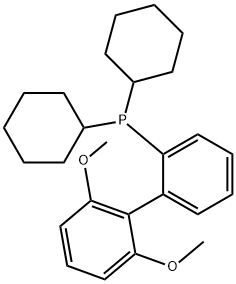
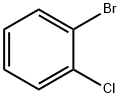
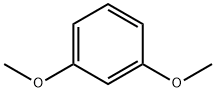
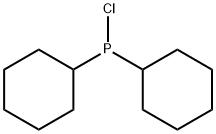
To a solution of 1,3-dimethoxybenzene (2 mL, 15.30 mmol) in anhydrous THF (35 mL) was slowly added n-butyllithium (nBuLi, 6.2 mL, 15.50 mmol) through a dropping funnel over 5 min at 0 °C. The reaction mixture was stirred at room temperature for 3.5 h. After stirring, 2-bromochlorobenzene (1.6 mL, 13.70 mmol) was added slowly dropwise through a syringe at 0 °C for 30 min. After stirring for 15 min, the reaction mixture was cooled to -78 °C and n-butyllithium (6.20 mL, 15.50 mmol) was again added slowly through a dropping funnel over 5 min. 30 min later, chlorodicyclohexylphosphine (3.03 mL, 13.70 mmol) was added. The reaction mixture was kept at -78 °C for 1 h, during which rapid mechanical stirring was performed. Subsequently, the reaction mixture was warmed to room temperature and the resulting precipitate was filtered through a silica gel sintered disc covered with a cellulose acetate layer and washed with 600 mL of ethyl acetate. The filtrate was concentrated by rotary evaporation and the resulting orange oil was recrystallized in acetone to give white crystalline S-Phos ligand in 36% yield (1.22 g, 2.97 mmol). Melting point: 163-165 °C (literature value 162.0-162.5 °C); Thin layer chromatography (TLC) conditions: ethyl acetate/cyclohexane (10/90), Rf = 0.65; 1H-NMR (CDCl3): δ = 0.99-1.26 (m, 10H, H(Cy)), 1.60-1.77 (m, 12H, H(Cy)), and 3.67 (s, 6H, Me), 6.58 (d, 2H, J = 8.2 Hz, H3' and H5'), 7.15-7.18 (m, 1H, H(Ar)), 7.18-7.42 (m, 3H, H(Ar)), 7.57 (d, 1H, J = 7.4 Hz, H(Ar)) ppm; 13C-NMR (CDCl3): δ = 26.5, 27.3, 27.4, 27.6, 29.0, 29.1, 29.8, 30.1, 33.8, 34.0 (C(Cy)), 55.3 (Cb), 103.1 (Ca), 126.2, 128.2, 128.8 (C3', C4', C5'), 130.9, 131.00, 132.4. 135.8 (C3, C4, C5, C6), 135.8, 136.1, 142.7, 143.1, 157.4 (C2', C6') ppm; IR (KBr): υ = 3000, 2923, 2851, 1588, 1471, 1442, 1428, 1108 cm-1.