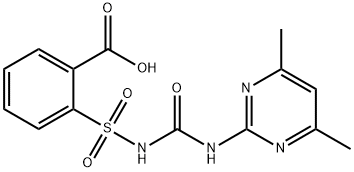
Sulfometuron is a herbicide which is normally used as the methyl derivative. It has a moderate aqueous solubility, is non-volatile and, based on its chemical properties, is mobile and may be expected to leach to groundwater. It is not generally persistent in soil systems but may be persistent in aquatic systems under certain conditions. It has a low mammalian toxicity and has a high potential to bioaccumulate. It is moderately toxic to most aquatic species, honeybees and earthworms but is less toxic to birds.
Industrial manufacture of sulfometuron is usually as the methyl variant and typically begins with synthesis of the substituted pyrimidinyl moiety, often via chlorination or activation at the 4-position to create a good leaving group for later coupling. In parallel, the methoxy-substituted benzenesulfonamide fragment is prepared by sulfonation of the anisole precursor, conversion to the sulfonyl chloride, and subsequent reaction with an amine to generate the sulfonamide intermediate. The key step is formation of the sulfonylurea linkage: the sulfonamide is reacted with an isocyanate or carbamoyl-activating reagent to generate a reactive carbamoyl intermediate, which is then coupled to the activated pyrimidine ring under controlled temperature and solvent conditions.
ChEBI: Sulfometuron is an N-sulfonylurea that is urea substituted by 4,6-dimethylpyrimidin-2-yl and (2-carboxyphenyl)sulfonyl groups at positions 1 and 3, respectively. It has a role as a herbicide and an EC 2.2.1.6 (acetolactate synthase) inhibitor. It is a member of benzoic acids, a member of pyrimidines, a N-sulfonylurea and a monocarboxylic acid.
Broad-spectrum, inhibits cell division. Inhibits plant amino acid synthesis - acetohydroxyacid synthase AHAS