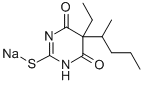
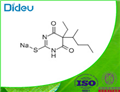
Thiopental Sodium is a Yellowish-white powder that is hygroscopic and readily soluble in water; its aqueous solution (1:40) is strongly alkaline (pH 9.5–11.2). It is soluble in alcohol and has a garlic-like odour. It is unstable; its aqueous solution undergoes hydrolysis when left standing. The dry powder is sealed in ampoules, and the solution is prepared immediately prior to use.
Sodium thiopental was first synthesised in the early 1930s by Ernest H. Volwiler and Donalee L. Tabern at Abbott Laboratories. Owing to its rapid onset of action, Ralph M. Waters first administered sodium thiopental for human anaesthesia on 8 March 1934.
A rapidly acting barbiturate administered
intravenously for general anesthesia and hypnosis.
Commonly known as “truth serum.”
Thiopental sodium is an organic sodium salt having thiopental(1) as the counter-ion. It has a role as an intravenous anaesthetic. It contains a thiopental(1-).
May cause respiratory failure; use onlywith
physician in attendance.
Thiopental is highly bound to albumin, and free drug availability is increased
in hypoproteinaemia. Protein binding is decreased by alkalaemia,
hyperventilation and some drugs that occupy the same albumin binding
sites, thereby increasing unbound thiopental concentrations. Metabolism
occurs predominantly in the liver, and the metabolites are excreted by the
kidneys. Only a small proportion is excreted unchanged in the urine. The
terminal elimination half-life is approximately 11.5h (longer in the elderly).
Elimination after an infusion is a zero-order process with 10%–15% of the
remaining drug metabolised each hour. Up to 30% of the original dose may
remain in the body at 24h, and a hangover effect is common. Accumulation
may result if further doses of thiopental are administered within 1–2 days.
Thiopental sodium is a short-acting intravenous
anesthetic used for brief surgical procedures
and induction of anesthesia. It is a potent,rapidly effective hypnotic. Sleep ensues within
30 – 60 s. A disadvantage is the lengthy hangover.
In the United States and Great Britain it is
the most widely used injection anesthetic. Abuse
can lead to addiction.
Poison by ingestion, intraperitoneal, rectal, subcutaneous, and intravenous routes. Human systemic effects by intraarterial route: acute arterial occlusion; by rectal route: respiratory depression, body temperature decrease, general anesthetic. An experimental teratogen. Experimental reproductive effects. An intravenous anesthetic. When heated to decomposition it emits toxic fumes of NO, and Na2O. See also PENTOTHAL and BARBITURATES
Veterinary Drugs and Treatments
Because of its rapid action and short duration, in young, healthy
animals, thiopental is excellent induction agent (rapid IV bolus)
for general anesthesia with other anesthetics or as the sole anesthetic
agent for very short procedures. In sick or debilitated animals,
thiopental may be used in a more cautious manner (IV, slowly to
effect).